
Decisive Leadership and Public Interest
Why in News?
- NITI Aayog organised a national workshop on ‘Leadership as Mission’ at Bharat Mandapam in New Delhi. In his inaugural address, Dr P. K. Mishra, Principal Secretary to the Prime Minister, emphasised the importance of decisive leadership in governance and the ability to translate policy vision into action.
This was the first in a series of five national workshops. Lessons from these workshops will inform the development of case studies and learning materials for civil service training institutes and educational institutions.
Ethical Foundations of Decisive Leadership
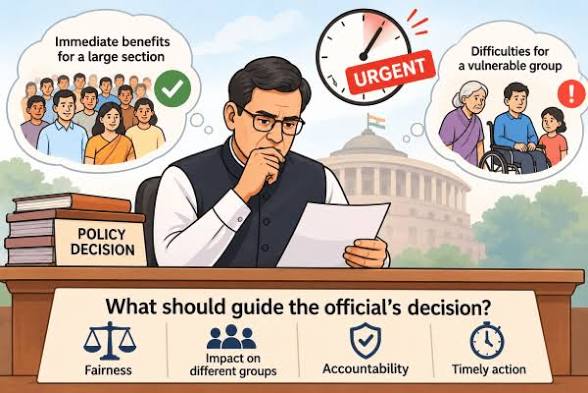
- Timeliness and evidence — Decisive leaders make timely decisions based on the available evidence and accept responsibility for the outcomes. Unnecessary delays can worsen the difficulties faced by people who depend on relief, pensions or other public services.
- Integrity and impartiality — Decisions should be guided by the public interest, lawful criteria and relevant facts. Integrity enables officials to carry out their duties without being swayed by personal interests or undue pressure.
- Empathy and ethical dilemmas — If a policy benefits a large section of the population but places a disproportionate burden on a vulnerable group, officials should hear that group’s concerns. They should assess the available options and incorporate measures to reduce potential harm into the decision.
Application in Citizen-Centric Governance
- Coordination during crises — Dr Mishra referred to the response to the 2001 Kutch earthquake and the coordinated action during the COVID-19 pandemic. During a crisis, clarifying responsibilities, setting priorities for the use of resources and informing citizens promptly can improve the implementation of decisions.
- Quality of service delivery and accountability — Citizens’ experience can be assessed by how easily they can access services, how they are treated and how long it takes to resolve their grievances. Recording the reasons for decisions and reviewing implementation in light of citizen feedback strengthen administrative accountability.
- Institutional capacity — Giving frontline officials clear authority, training and resources enables them to address local problems promptly. Clear procedures and regular monitoring help maintain continuity in public services even when leadership changes.
Key Definitions
Term | Definition |
| Foundational values of the civil service | The ethical principles that guide the conduct and decisions of civil servants. These include integrity, impartiality, non-partisanship, objectivity, dedication to public service, and empathy, tolerance and compassion towards weaker sections of society. |
| Ethical dilemma in public administration | A situation in which two or more ethical values, duties or obligations conflict, and giving priority to one makes it difficult to uphold another fully. |
| Accountability | The obligation of a public official or institution to explain its decisions, actions or omissions, submit them to scrutiny and accept responsibility for the consequences. |
| Public interest | The collective welfare of society, which includes protecting citizens’ rights, using public resources equitably and taking into account the interests of weaker sections. |
Multiple-Choice Question
With reference to decisive leadership in citizen-centric governance, consider the following statements.
- The potential effects on different social groups can be assessed while making timely decisions.
- If a policy benefits the majority of citizens, there is no need to review its adverse effects on vulnerable groups.
- Recording the reasons for a decision and reviewing its implementation strengthen administrative accountability.
Which of the statements given above are correct?
(A) 1 and 2 only
(B) 1 and 3 only
(C) 2 and 3 only
(D) 1, 2 and 3
Answer
(B) 1 and 3 only
Explanation
Statements 1 and 3 are correct. Assessing potential effects helps officials make impartial decisions. Recording the reasons for decisions and reviewing their implementation strengthen administrative accountability. Statement 2 is incorrect because a policy’s adverse effects on vulnerable groups must be reviewed alongside its wider benefits.