
Contempt of Court: Why Defying a Judge’s Order Is Not Always Contempt
Indian law distinguishes civil contempt, criminal contempt and offences committed in the presence of a court. Subordinate courts possess limited summary powers, while the Supreme Court and High Courts exercise broader constitutional contempt jurisdiction.

- Syllabus Mapping: GS Paper II — Judiciary, Constitutional Provisions, Separation of Powers, Rule of Law and Judicial Accountability.
- Source: The Indian Express.
Why in News?
The Supreme Court questioned a Bihar Additional Sessions Judge who had convicted a Superintendent of Police for contempt under Section 384 of the Bharatiya Nagarik Suraksha Sanhita (BNSS).
The police officer had allegedly failed to comply with judicial directions and was fined ₹1.
The central issue was whether disobedience of an order outside the courtroom could be punished under a provision intended for offences committed in the court's presence.
What Is Contempt of Court?
Contempt protects the administration of justice from deliberate obstruction or interference.
- Article 129: Declares the Supreme Court a court of record with power to punish for contempt of itself.
- Article 215: Gives High Courts corresponding constitutional powers.
- Contempt of Courts Act, 1971: Defines civil and criminal contempt and regulates their exercise.
These powers protect judicial functioning, not the personal prestige of individual judges.
Civil Contempt vs Criminal Contempt
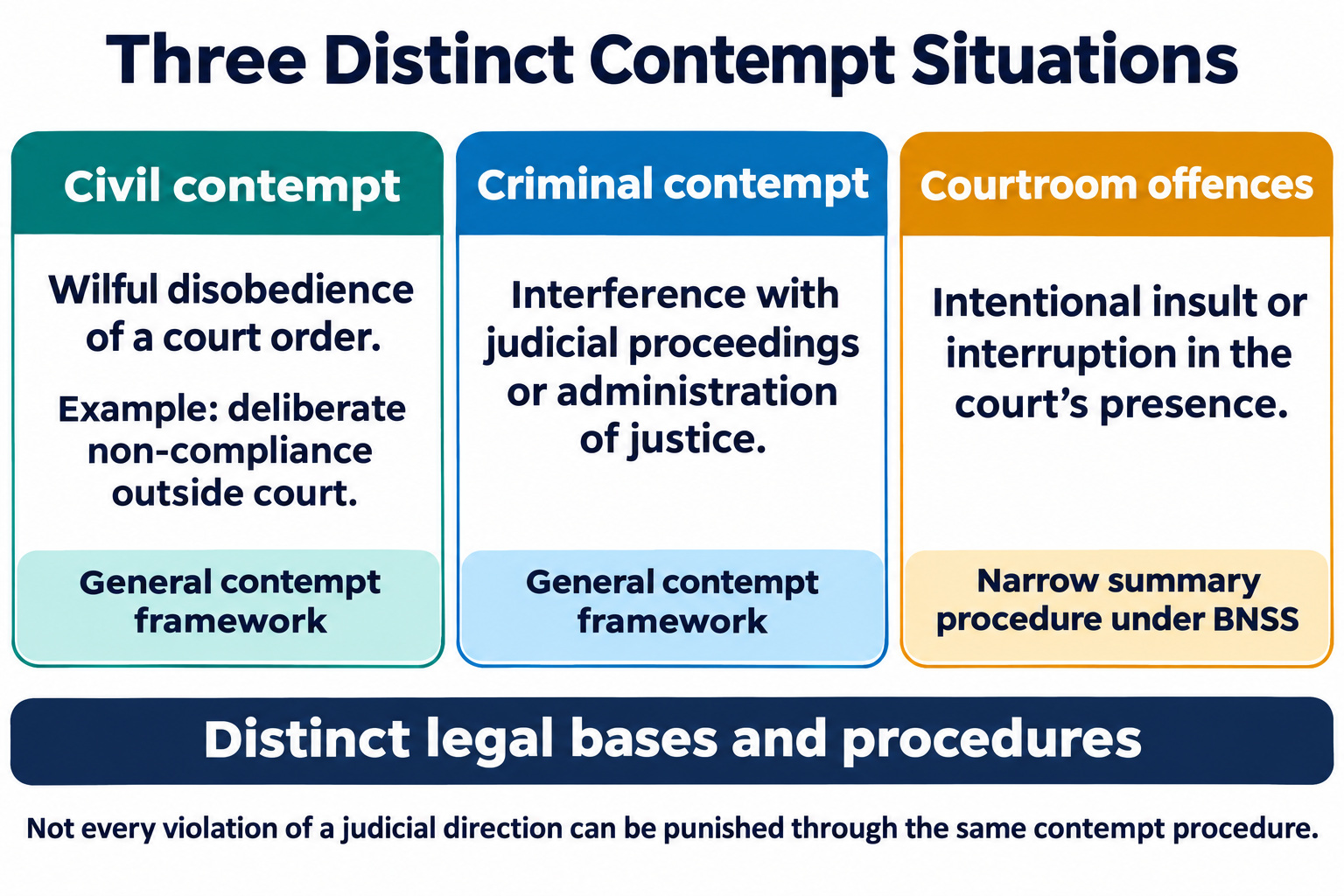
Civil contempt involves wilful disobedience of a court's judgment, direction or order, or wilful breach of an undertaking given to a court.
Criminal contempt involves conduct that:
- scandalises or lowers the authority of a court;
- prejudices or interferes with judicial proceedings;
- obstructs the administration of justice.
Crucial distinction: Disobedience can constitute civil contempt, but it does not automatically amount to a criminal offence committed in the court's presence.
What Does Section 384 of BNSS Provide?
Section 384 replaces Section 345 of the former CrPC and deals with specified offences committed in the view or presence of a Civil, Criminal or Revenue Court.
Examples include intentionally insulting or interrupting judicial proceedings and certain refusals to answer or produce information.
- The court may take immediate cognisance after providing an opportunity to explain.
- It may impose a fine of up to ₹1,000 under the provision.
- Its jurisdiction is limited to designated offences committed directly before the court.
The provision does not create a general power to punish every instance of non-compliance with judicial orders.
Why Did the Supreme Court Question the Bihar Judge?
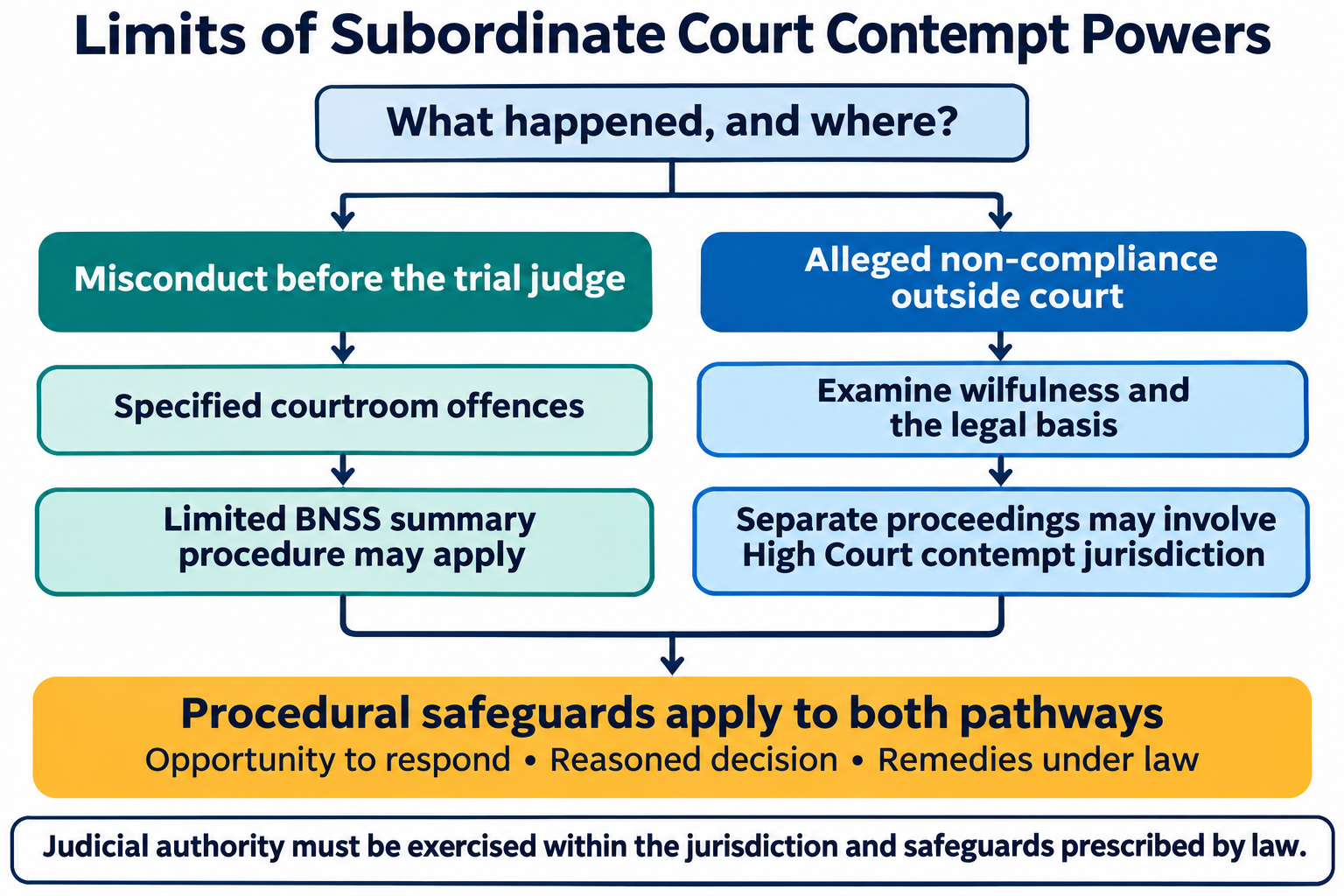
The alleged police non-compliance occurred outside the courtroom.
Therefore, the requirements of Section 384's in-court jurisdiction were not satisfied merely because the police officer had disobeyed a direction.
The Supreme Court indicated that concerns over defiance of judicial orders should instead be raised before the High Court through the appropriate legal process.
This protects the distinction between subordinate courts' limited statutory powers and the broader contempt jurisdiction exercised by constitutional courts.
Core Constitutional Lesson
Judicial authority is not unlimited judicial discretion.
- Wilful non-compliance may attract civil contempt through an appropriate proceeding.
- Misconduct directly before a trial court may fall within the narrow BNSS procedure.
- Constitutional courts possess broader contempt powers, subject to statutory safeguards.
The rule of law requires courts to enforce their orders while respecting jurisdiction, proportionality and due process.
---
Probable Mains Question
“The power to punish for contempt is essential for judicial independence, but its exercise must remain subject to jurisdictional limits and procedural safeguards.” Discuss with reference to constitutional provisions and Section 384 of the BNSS.
---
Prelims Drill
MCQ 1
With reference to contempt of court in India, consider the following statements:
1. The Supreme Court derives contempt powers from Article 129.
2. High Courts possess constitutional contempt powers under Article 215.
3. Wilful disobedience of a judicial order can never constitute civil contempt.
Which of the statements given above are correct?
A. 1 only
B. 1 and 2 only
C. 2 and 3 only
D. 1, 2 and 3
Correct Answer: B
Explanation: Articles 129 and 215 confer constitutional contempt powers. Wilful disobedience can constitute civil contempt under the Contempt of Courts Act, 1971.
MCQ 2
With reference to Section 384 of the Bharatiya Nagarik Suraksha Sanhita, consider the following statements:
1. It concerns certain specified offences committed in the view or presence of a court.
2. It provides a limited summary procedure for dealing with such offences.
3. It empowers every subordinate court to punish any violation of its orders committed anywhere.
Which of the statements given above are correct?
A. 1 only
B. 1 and 2 only
C. 2 and 3 only
D. 1, 2 and 3
Correct Answer: B
Explanation: Section 384 applies to specified offences committed in the court's view or presence. It does not confer unlimited contempt jurisdiction on subordinate courts.