Chola Maritime Trade Network
Chola maritime influence rested on agricultural wealth, port towns, merchant guilds, temples, naval strength and diplomacy across the Indian Ocean.
Chola Maritime Trade Network
- Syllabus Mapping: GS Paper I — Indian Culture, South Indian Kingdoms, Trade Networks and Cultural Contacts.
- Source & Date: The Indian Express, 16 October 2026.
Why in News?
A recent excavation at Poompuhar in Tamil Nadu has produced fresh evidence of overseas trade. Archaeologists found a West Asian torpedo jar, terracotta ring wells and more than 250 ceramic fragments. Torpedo jars were used to transport liquids such as wine and oil, making the discovery important evidence of Poompuhar's links with West Asia and the Mediterranean world.
The findings highlight how the Cholas developed one of medieval India's most extensive maritime commercial networks.
Foundations of Chola Trade
The later Cholas became a major peninsular power from the ninth century. Under rulers such as Rajaraja I and Rajendra I, their influence extended across Sri Lanka and the Bay of Bengal.
Control of the fertile Kaveri delta provided large agricultural surpluses. This wealth supported cities, temples, armies and overseas commerce.
Commercial towns known as nagaram connected local producers with larger markets. Major temples also became economic centres because they owned land, employed workers and created demand for cloth, jewels, sandalwood, pearls and other valuable goods.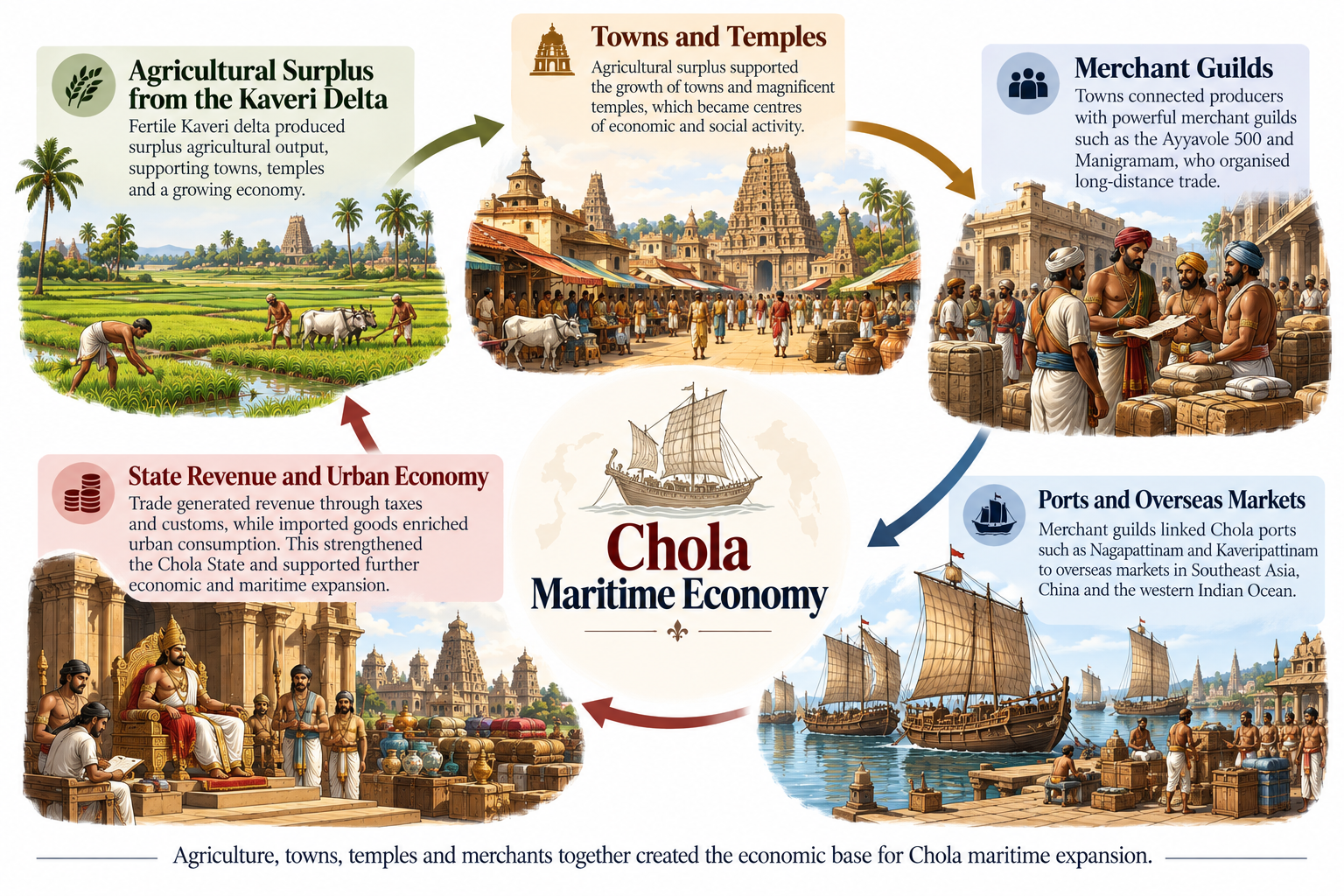
Merchant Guilds Drove Commerce
Powerful merchant associations such as Ainurruvar or Ayyavole, Manigramam, Nanadesi and Anjuvannam operated across South India and overseas.
These organisations coordinated trade, worked with artisan groups and sometimes maintained their own armed protection. Chola rulers provided security and favourable commercial conditions, while merchant communities contributed to temple administration and supported royal authority.
The relationship therefore benefited both sides. The State gained commerce and revenue, while merchants gained safer routes and access to expanding markets.
Ports Connected Asia
Ports such as Nagapattinam and Kavirippoompattinam became important links in Indian Ocean commerce. Maritime routes connected the Coromandel Coast with Sri Lanka, Southeast Asia, China and West Asia.
The growth of sea routes was also encouraged when conflicts made parts of the traditional overland Silk Route less reliable. Indian Ocean shipping offered an alternative route between western Asia and China.
The Cholas maintained commercial contacts even with Srivijaya, despite periods of political and military rivalry. Chola rulers also sent commercial missions to Song China.
Goods and Emporium Trade
Chola trade included cotton textiles, spices, rice, sandalwood, camphor, pearls, ivory and precious stones. Arabian horses were important imports because cavalry remained valuable for warfare.
Many goods passing through Chola ports originated elsewhere. West Asian frankincense travelled through the Coromandel Coast towards China, while Chinese porcelain moved towards western markets.
This reflected the growth of emporium trade. Ports increasingly became centres where cargo was collected, divided, exchanged and re-exported instead of moving directly from producer to final consumer.
Trade and Cultural Exchange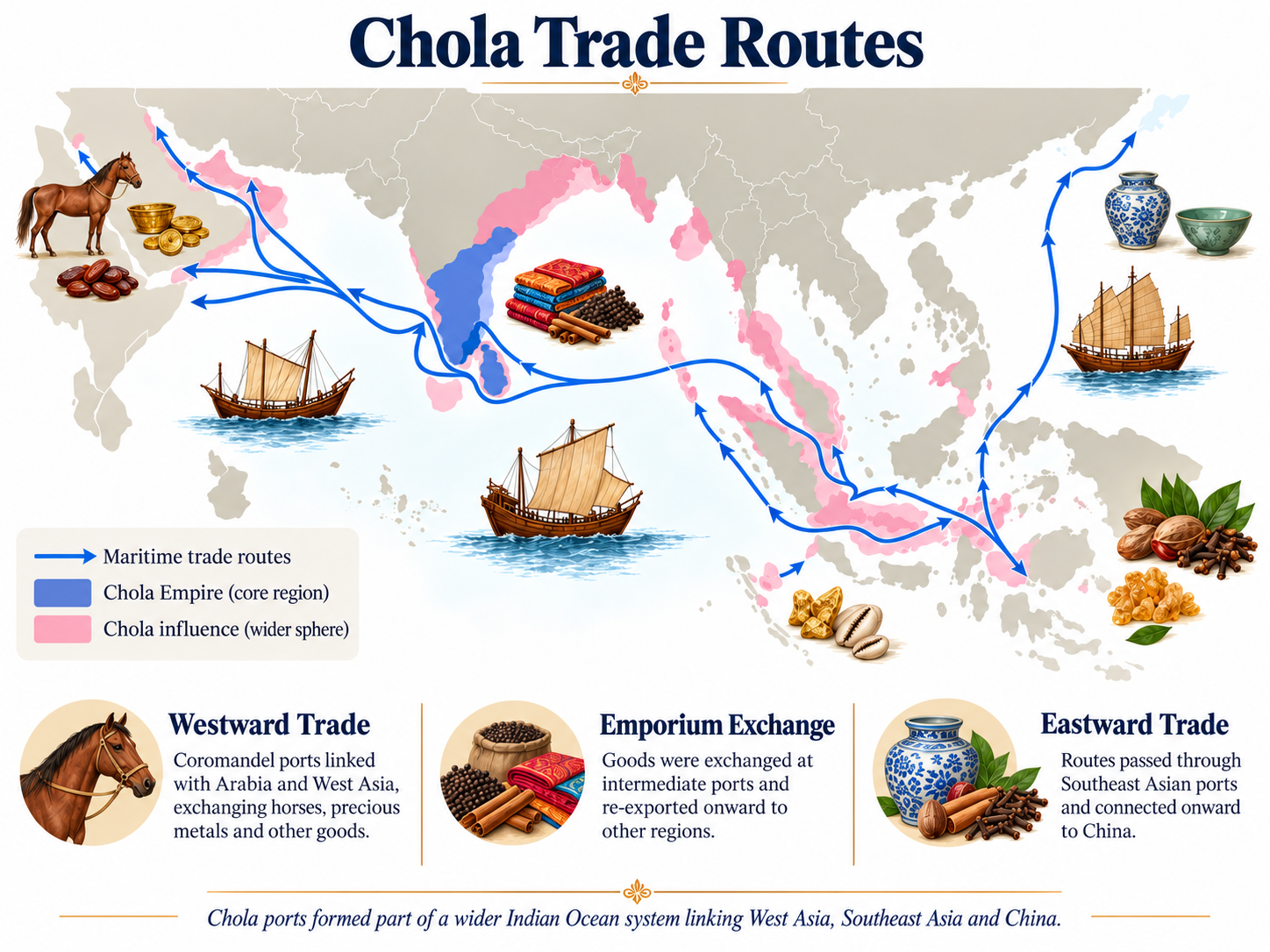
Commercial networks also moved ideas, religious traditions and communities. Tamil merchants established settlements and religious institutions abroad, while Buddhism and Brahmanical traditions travelled along the same maritime routes.
Tamil inscriptions and evidence of Hindu religious activity have even been found in China.
The spread of cultural practices was therefore closely connected with merchants, ports and mobility rather than being simply the result of political conquest.
Core Policy Lesson
The Chola maritime system shows that political power, agricultural prosperity, commercial institutions and naval capacity reinforced one another.
The Cholas succeeded because they connected their inland economy with Indian Ocean markets through strong ports, organised merchant guilds and diplomatic relationships. Their experience also shows how maritime trade can create not only economic networks but long-lasting cultural connections across regions.
Probable Mains Question
“Chola maritime expansion was driven as much by commercial institutions as by naval power.” Discuss the role of ports, merchant guilds and temples in the growth of Chola overseas trade.
Prelims Drill
MCQ 1
With reference to commercial organisation during the Chola period, consider the following statements:
- Nagaram referred to commercial towns that participated in wider networks of production and exchange.
- Merchant associations such as Ayyavole and Manigramam operated only within territories directly administered by Chola rulers.
- Temples could influence commercial activity by creating demand for valuable commodities and administering economic resources.
Which of the statements given above are correct?
A. 1 only
B. 1 and 3 only
C. 2 and 3 only
D. 1, 2 and 3
Correct Answer: B
Explanation: Nagaram were important commercial centres, while temples participated actively in the economic life of Chola society. Merchant guilds had networks extending beyond the political boundaries of the Chola kingdom, including overseas connections.
MCQ 2
With reference to maritime commerce in the Chola period, consider the following statements:
- The development of emporium trade allowed ports to redistribute goods that had originated in other regions.
- Chola commercial relations with Southeast Asia necessarily ended whenever political or military rivalry arose.
- Goods moving through Coromandel ports could connect West Asian producers with East Asian consumers.
Which of the statements given above are correct?
A. 1 only
B. 1 and 2 only
C. 1 and 3 only
D. 2 and 3 only
Correct Answer: C
Explanation: Emporium trade involved collecting and re-exporting goods through major ports. Commercial relations could continue despite political competition, as seen in Chola interaction with Srivijaya. Coromandel ports formed an important link between western and eastern parts of the Indian Ocean trading system.