
Children’s Right to Internet Access
The Supreme Court has linked children’s access to and use of the Internet with fundamental rights while emphasising that digital freedom and online safety should not be treated as opposing objectives.
Children’s Right to Internet Access
- Syllabus Mapping: GS Paper II — Fundamental Rights, Rights of Children, Judiciary and Governance; GS Paper III — Digital Technology, Cyber Safety and Artificial Intelligence.
- Source & Date: The Hindu, 30 October 2026.
Why in News?
The Supreme Court has held that children have a fundamental right to access and use the Internet, flowing from Article 21 read with Article 19(1)(a).
The judgment also rejects the idea that child safety requires blanket digital restrictions. Instead, it favours proportionate and intelligent safeguards that protect children while preserving their ability to learn, communicate and participate online.
Access Is More Than Connectivity
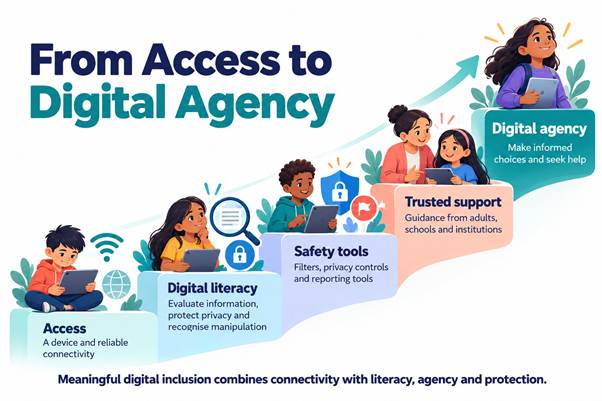
Providing a smartphone or Internet connection does not automatically create meaningful digital participation.
Children also need the ability to verify information, protect personal data, recognise manipulation, respond to cyberbullying and understand how recommendation systems shape what they see.
This broader capacity can be described as a digital agency: the ability to use digital systems independently, critically and safely.
Why Blanket Bans Can Fail
Complete restrictions may appear protective but can create unintended consequences.
Children may shift to less visible or less regulated platforms, making supervision more difficult. Fear of punishment may also discourage them from reporting online abuse, harassment or exploitation.
The better approach is therefore not complete exclusion, but age-appropriate access combined with safeguards and trusted channels for help.
AI Literacy Is Becoming Essential
Artificial intelligence adds a new dimension to digital literacy.
Children increasingly need to understand that AI systems can produce inaccurate information, reflect bias and generate convincing but false outputs.
They also need to know when AI should support learning and when it may begin to replace independent reasoning.
Schools therefore need to teach AI literacy alongside traditional digital literacy, including privacy protection, verification and responsible use.
Child Mode and Teen Mode
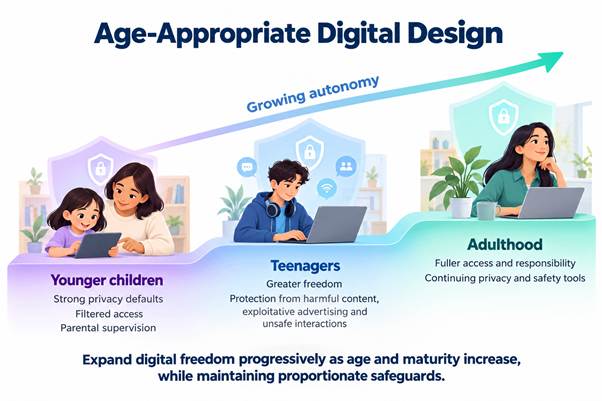
Age-appropriate design can provide a middle path between unrestricted access and blanket prohibition.
A Child Mode could include stronger privacy defaults, filtered content, restricted advertising and tighter interaction settings.
A Teen Mode should allow greater autonomy while still providing safeguards different from those applied to adults.
The key principle is progressive autonomy: protection should gradually reduce as children gain maturity and digital competence.
Safety-by-Design
Responsibility cannot rest only with parents.
Technology companies can build safety directly into devices, operating systems, telecom services, social platforms and AI tools.
Possible measures include privacy-protective defaults, age-sensitive recommendation systems, restrictions on targeted advertising, safer communication settings and simple reporting mechanisms.
This approach is known as safety-by-design, where protection is built into the product rather than added only after harm occurs.
Role of Schools and Government
Schools must build digital and AI capability as part of mainstream education.
Governments need to create proportionate regulatory standards while avoiding excessive restrictions that undermine constitutional freedoms.
Parents require usable tools and awareness, while platforms need clear accountability for designing environments used by children.
Core Policy Lesson
Children's digital rights should not be framed as a choice between access and safety.
The more sustainable approach is to combine constitutional freedom with digital literacy, progressive autonomy and safety-by-design.
The goal is not to create a permanently restricted Internet for children, but to help them develop the competence required to navigate the wider digital world safely and independently.
Probable Mains Question
“Protecting children online does not require choosing between digital freedom and digital safety.” Discuss with reference to constitutional rights, digital literacy and age-appropriate technology design.
Prelims Drill
MCQ 1
With reference to digital rights of children, consider the following statements:
- Freedom of speech and expression under Article 19(1)(a) can have relevance to digital access.
- Article 21 can extend beyond mere physical survival to conditions necessary for a meaningful life.
- Protecting children online necessarily requires complete prohibition of Internet access.
Which of the statements given above are correct?
A. 1 only
B. 1 and 2 only
C. 2 and 3 only
D. 1, 2 and 3
Correct Answer: B
Explanation: Articles 19(1)(a) and 21 can support digital access and participation. Child protection does not automatically require blanket prohibition and can instead rely on proportionate safeguards.
MCQ 2
Consider the following statements regarding age-appropriate digital design:
- Privacy settings can be made stricter by default for younger users.
- Teenagers may require a different balance between autonomy and protection than very young children.
- Safety-by-design places responsibility exclusively on parents.
Which of the statements given above are correct?
A. 1 only
B. 1 and 2 only
C. 2 and 3 only
D. 1, 2 and 3
Correct Answer: B
Explanation: Age-appropriate design recognises different levels of maturity and autonomy. Safety-by-design also places responsibility on technology providers and institutions, not only parents.
More Current Affairs - Daily
- Nashik–Trimbakeshwar Simhastha Kumbh Mela (2026–28): Faith, Heritage and Public Governance 31 Oct 2026
- Punjab’s Drug Crisis: Challenges of Public Health, Law Enforcement and Rehabilitation 31 Oct 2026
- Growing GLOF Risk in the Himalayas 31 Oct 2026
- Siang Upper Multipurpose Project: Questions of Development, Displacement and Environmental Ethics 31 Oct 2026