
Dr. Ambedkar’s Public Conscience: The Moral Foundation of Democracy
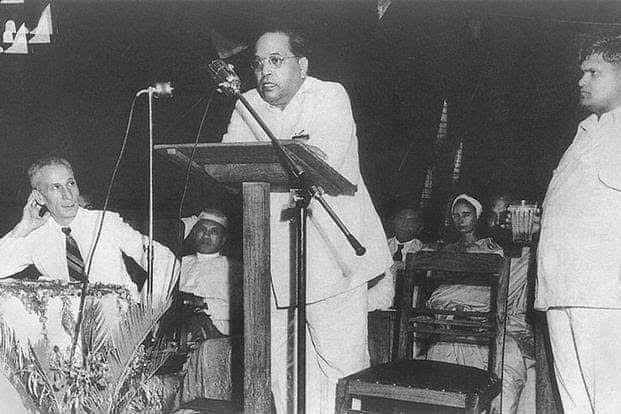
B.R. Ambedkar argued that constitutional rights cannot survive through legal enforcement alone. Democracy requires public conscience, fraternity and social solidarity so that people resist injustice even when they are not personally affected.
- Syllabus Mapping: GS Paper II — Constitution, Fundamental Rights, Social Justice and Democracy; GS Paper IV — Ethics, Conscience, Empathy and Moral Values.
- Source: The Indian Express.
Why in News?
B.R. Ambedkar’s understanding of public conscience offers an important explanation of why constitutional guarantees alone cannot secure democracy.
His central argument was that laws may recognise equal rights, but those rights become meaningful only when society develops the moral willingness to defend them.
What Did Ambedkar Mean by Public Conscience?
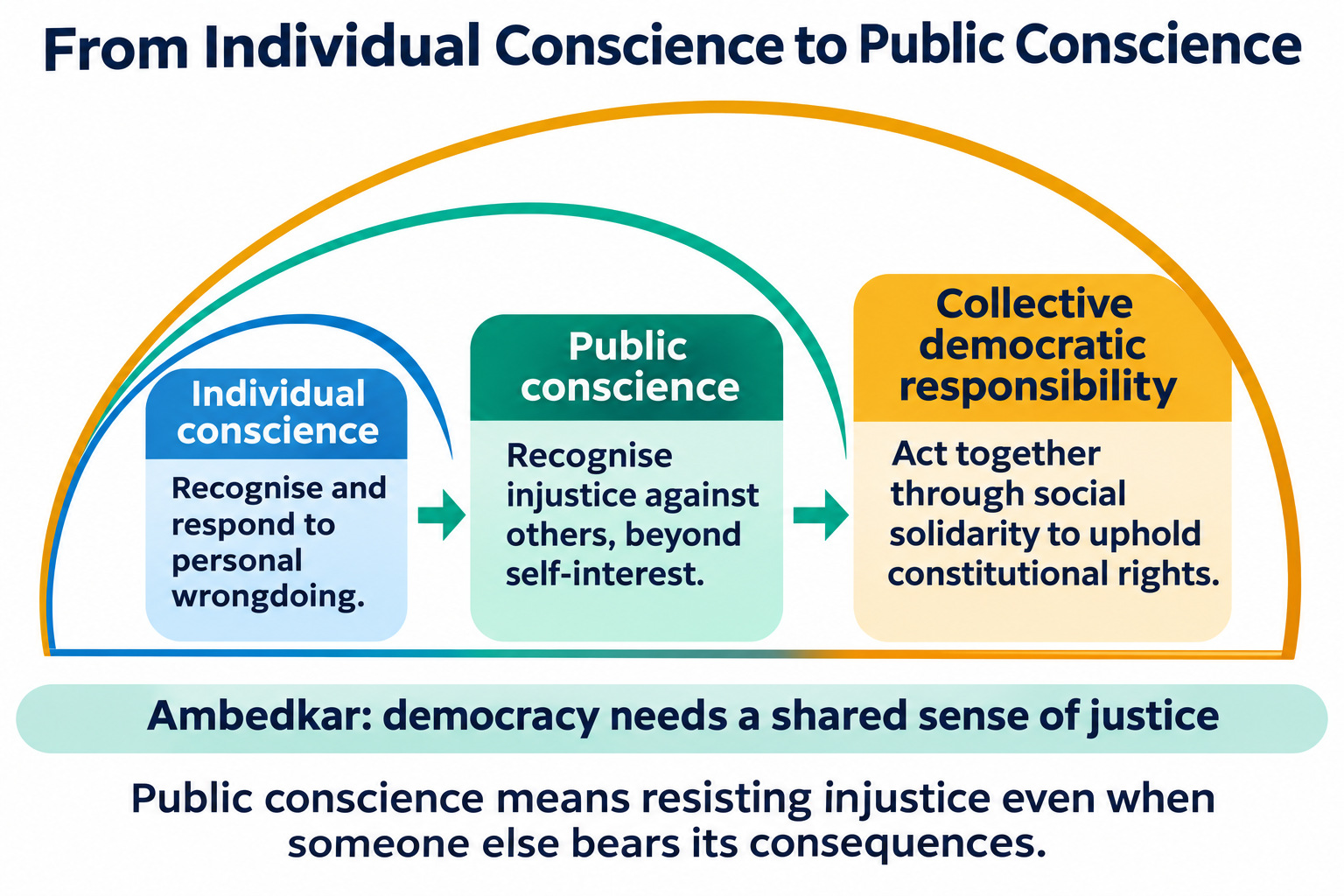
For Ambedkar, public conscience is the capacity to recognise and oppose injustice regardless of who suffers it.
- Individual conscience: Moral awareness concerning one's own actions.
- Public conscience: Collective sensitivity to injustice inflicted on others.
- It requires citizens to oppose discrimination even when they do not personally experience it.
In his 1943 address, Ranade, Gandhi and Jinnah, Ambedkar argued that fundamental rights remain insecure when society itself refuses to recognise them.
Why Are Constitutional Rights Alone Insufficient?
Ambedkar distinguished between legal recognition and social enforcement.
- Legislatures can enact equality and anti-discrimination laws.
- Courts can punish identifiable offenders.
- However, widespread social hostility may make those rights difficult to exercise in practice.
His examples included racial discrimination in America, persecution of Jews in Germany and untouchability in India.
The key problem is that law can punish individual violations but cannot easily transform an entire society determined to defy equality.
How Does the Caste System Weaken Public Conscience?
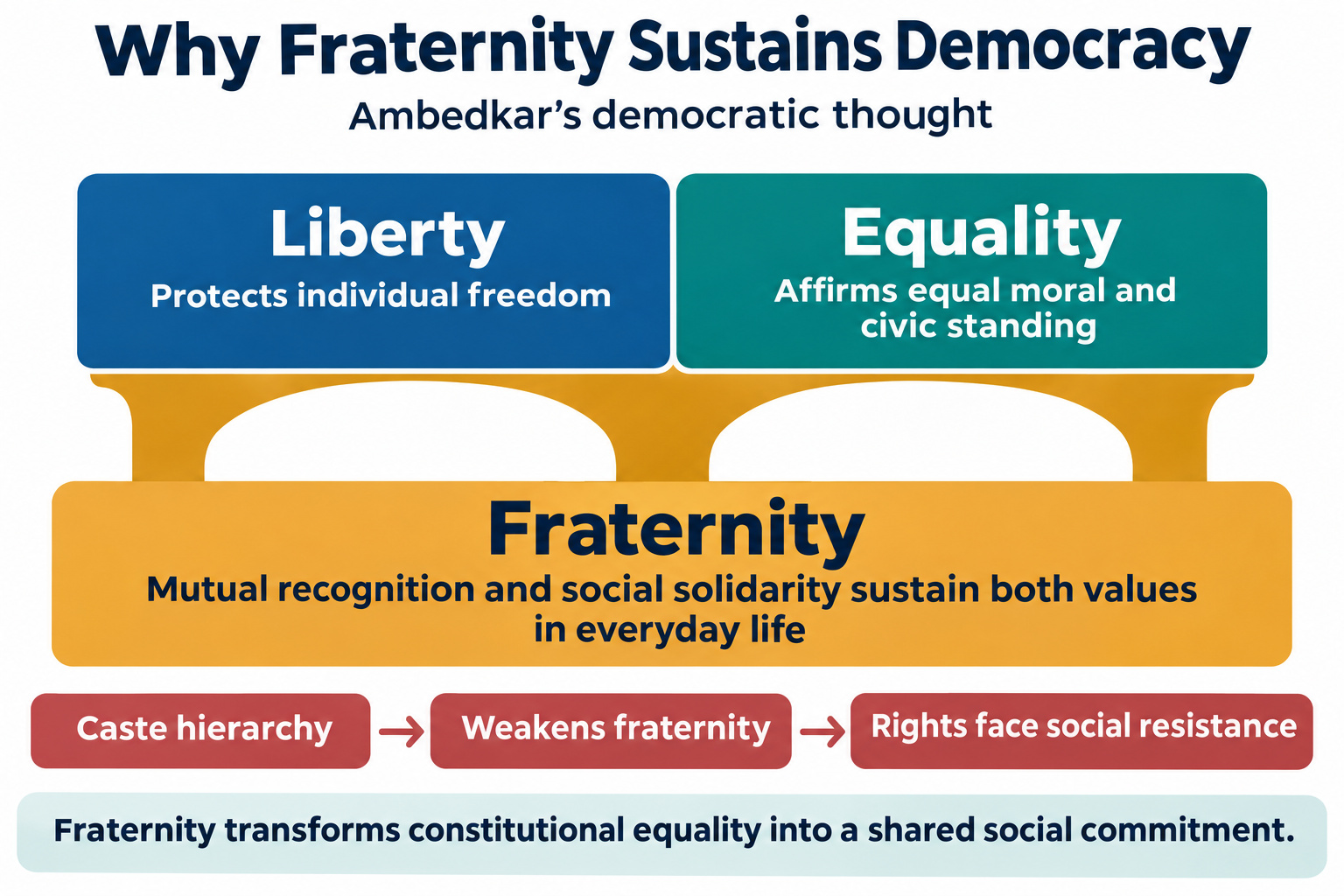
Ambedkar identified caste-based graded inequality as a major obstacle to democratic solidarity.
- Society is divided into hierarchically ranked communities.
- Privilege and social status differ across groups.
- Individuals may tolerate injustice when its victims belong to another caste.
Such divisions obstruct fraternity, which Ambedkar regarded as essential alongside liberty and equality.
Without fraternity, democracy may survive institutionally while remaining socially unequal.
How Can Fraternity Be Cultivated?
Ambedkar rejected the assumption that fraternity automatically develops among individuals.
He emphasised active social participation through shared experiences, common institutions and everyday interaction.
- Inter-caste socialisation can weaken inherited social barriers.
- Shared meals, community participation and collective responsibilities can strengthen mutual recognition.
- Social reform must cultivate empathy through practice rather than merely preach moral ideals.
He also viewed Buddhism as a practical ethical tradition, particularly through Prajna (understanding), Karuna (compassion) and Maitri (fellowship).
Core Constitutional and Ethical Lesson
Ambedkar's vision connects constitutional democracy with social democracy.
A Constitution can establish rights, institutions and procedures, but their effectiveness depends on citizens developing solidarity with those who experience injustice.
The wider lesson applies to caste discrimination and other forms of structural inequality: democracy requires not only institutions that prohibit injustice, but also a society willing to challenge it.
---
Probable Mains Question
“Constitutional rights cannot be effectively protected without a corresponding social conscience.” Examine this statement in the light of B.R. Ambedkar's understanding of fraternity and democratic morality.
---
Prelims Drill
MCQ 1
With reference to B.R. Ambedkar's concept of public conscience, consider the following statements:
1. It requires opposition to injustice even when one is not personally affected.
2. It assumes that constitutional provisions alone are sufficient to secure equality.
3. It connects the effectiveness of rights with the moral attitudes of society.
Which of the statements given above are correct?
A. 1 only
B. 1 and 3 only
C. 2 and 3 only
D. 1, 2 and 3
Correct Answer: B
Explanation: Ambedkar argued that rights require social recognition and protection. Public conscience extends moral responsibility beyond personal interests.
MCQ 2
Consider the following statements regarding B.R. Ambedkar's understanding of fraternity:
1. Fraternity helps connect liberty and equality within democratic society.
2. Caste-based graded inequality can weaken social solidarity.
3. Fraternity necessarily develops without deliberate social interaction or reform.
Which of the statements given above are correct?
A. 1 only
B. 1 and 2 only
C. 2 and 3 only
D. 1, 2 and 3
Correct Answer: B
Explanation: Ambedkar saw fraternity as essential to social democracy and believed that it must be actively cultivated through shared social life and ethical practice.