
AI Values, Consciousness and the Ethics of Moral Design
The growing social influence of AI raises two distinct but connected questions: which values should be embedded in AI systems, and whether human-like behaviour can justify claims of consciousness or moral status.
AI Values, Consciousness and the Ethics of Moral Design
- Syllabus Mapping: GS Paper IV — Ethics, Human Values and Applied Ethics; GS Paper III — Science and Technology, Artificial Intelligence and Emerging Technologies.
- Source & Date: The Indian Express, 7 October 2026.
Why in the News?
AI company Anthropic has been consulting religious leaders and philosophers to help shape the values and moral behaviour of its Claude AI system. The consultations have examined what kind of character Claude should display, which ethical traditions should inform its behaviour, and how an AI system should respond to increasingly complex moral questions.
The discussions have also moved into a more controversial area: whether advanced AI systems themselves could possess consciousness or moral status. Some participants said Anthropic representatives were seriously considering the possibility, while others remained sceptical. There is currently no scientific consensus or agreed test establishing consciousness in existing AI systems.
The debate is significant because people increasingly use conversational AI not only for information but also for advice involving relationships, ethics, religion and personal judgement.
AI Alignment Is Moving Beyond Technical Safety
Anthropic’s consultations with religious leaders and philosophers reflect a wider shift in AI safety.
The issue is no longer limited to preventing harmful outputs or making models follow instructions. Companies are increasingly confronting questions about the character, values and judgement that AI systems should display.
This can be understood as:
Technical safety → behavioural alignment → value alignment → moral judgement
Once AI systems are used for advice on relationships, morality, spirituality or difficult personal decisions, the values embedded in their behaviour can influence human choices.
Value Alignment Raises the Question of “Whose Values?”
A model cannot respond to every ethical problem using purely technical rules.
Moral questions often involve conflicts between values such as:
autonomy ↔ welfare
freedom ↔ harm prevention
individual rights ↔ community obligations
Religious and philosophical traditions offer different frameworks for resolving such tensions.
The deeper governance problem is therefore not simply how to make an AI system “ethical”, but who gets to define ethical behaviour.
If a small number of companies make these choices, their assumptions may be embedded in systems used across societies with very different moral traditions.
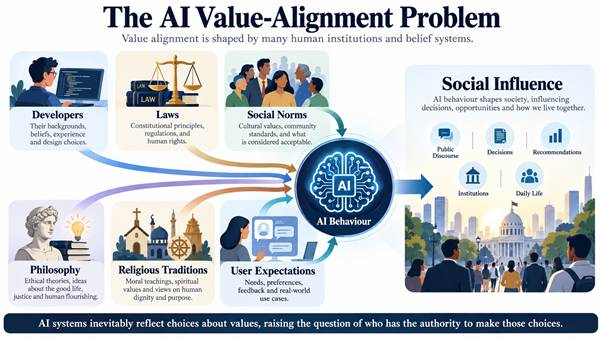
Value Pluralism Limits a Single Universal Moral Framework
Societies do not always agree on what constitutes the right moral decision.
This creates a problem of value pluralism: several legitimate moral values may coexist and sometimes conflict.
An AI system designed around one dominant moral tradition could therefore produce culturally narrow answers when deployed globally.
The risk is:
Dominant developer values → global AI deployment → cultural value export
This is why transparent and contestable value-setting may be more legitimate than treating one corporate framework as universally applicable.
Human-Like Behaviour Does Not Establish Consciousness
The second debate concerns whether advanced AI systems could themselves be conscious.
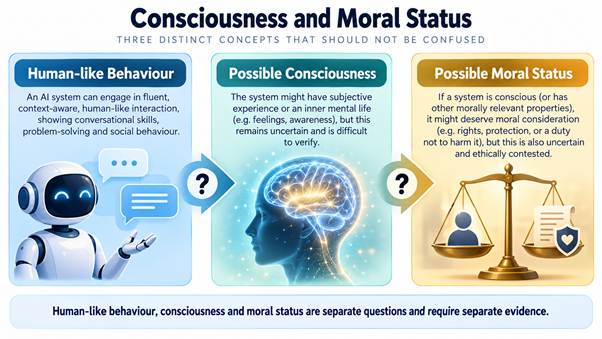
Current models can produce language that appears reflective, emotional or self-aware. But convincing behaviour is not the same as evidence of subjective experience.
The fundamental distinction is:
Human-like output ≠ demonstrated consciousness
There is currently no agreed scientific test capable of establishing machine consciousness.
This makes strong claims about AI consciousness epistemically uncertain.
Anthropomorphism Can Distort Human Judgement
Humans naturally attribute intentions, emotions and personality to entities that display human-like behaviour.
This tendency is called anthropomorphism.
With conversational AI, it may lead users to infer emotions or consciousness from fluent language even when the underlying system provides no independent evidence of subjective experience.
The risk chain is:
Human-like language → emotional attribution → assumption of consciousness → misplaced trust or moral authority
This is particularly important when users seek moral or spiritual guidance from AI systems.
Moral Status Is Distinct from Consciousness
Even if a system were someday shown to possess consciousness, a further question would arise: does it possess moral status?
Moral status means that an entity deserves moral consideration in its own right.
Questions would include whether the entity can:
- experience harm,
- possess interests,
- suffer,
- or have claims that humans are morally obliged to respect.
Thus:
Consciousness question → does subjective experience exist?
Moral-status question → what obligations would follow?
The two should not be treated as identical.
AI Should Not Become an Automatic Moral Authority
Another concern is the tendency to elevate AI from a decision-support tool into an authority on ethics, religion or meaning.
AI systems generate outputs from learned patterns and design choices. They do not automatically acquire moral legitimacy because their responses are fluent or persuasive.
The relevant principle is:
Computational capability ≠ moral authority
Human beings and democratic institutions must therefore retain responsibility for contested social and ethical decisions.
AI Governance Requires Value Transparency
The larger governance challenge is to make value choices visible and contestable.
Useful safeguards include:
transparent principles + multidisciplinary participation + cultural diversity + independent scrutiny + user agency
Religious and philosophical consultation can broaden the range of perspectives considered, but no single tradition, company or technical team can legitimately settle moral questions for all societies.
The Core Policy Lesson
The debate around Claude highlights two separate issues that should not be collapsed into one.
First, AI systems already require human choices about values and acceptable behaviour.
Second, whether such systems themselves possess consciousness or moral status remains scientifically unresolved.
The durable policy challenge is therefore:
Align powerful AI with human values without mistaking simulated human behaviour for proven human-like consciousness.
Probable Mains Question
“AI alignment is not merely a technical problem; it is also a question of moral authority, cultural pluralism and institutional legitimacy.” Discuss.
Prelims Drill
MCQ 1
With reference to Artificial Intelligence ethics, consider the following statements:
- AI alignment refers broadly to designing AI systems so that their behaviour remains consistent with intended human goals and values.
- Value pluralism refers to the coexistence of multiple legitimate values that may sometimes conflict.
- AI alignment can be solved entirely through higher computing power without making normative choices.
Which of the statements given above are correct?
A. 1 only
B. 1 and 2 only
C. 2 and 3 only
D. 1, 2 and 3
Correct Answer: B
Explanation: AI alignment involves bringing system behaviour into line with intended human objectives and values. Value pluralism recognises that legitimate values can conflict. Greater computational power alone cannot determine which moral values an AI system should follow.
MCQ 2
Consider the following statements:
- Anthropomorphism refers to attributing human characteristics or intentions to non-human entities.
- Human-like linguistic behaviour by an AI system is, by itself, conclusive scientific proof of consciousness.
- Moral status concerns whether an entity deserves moral consideration in its own right.
Which of the statements given above are correct?
A. 1 only
B. 1 and 3 only
C. 2 and 3 only
D. 1, 2 and 3
Correct Answer: B
Explanation: Anthropomorphism involves assigning human-like traits to non-human entities. Fluent or human-like AI behaviour does not by itself establish consciousness. Moral status concerns whether an entity has interests or characteristics that warrant moral consideration.
More Current Affairs - Daily
- Election Commission of India: Constitutional Design and Evolution into a Three-Member Body 12 Oct 2026
- Loknayak Jayaprakash Narayan: Total Revolution and Contribution to Democracy 12 Oct 2026
- India’s Russia-Ukraine Initiative: From Black Sea Security to Strategic Autonomy 12 Oct 2026
- Jayaprakash Narayan: Architect of Total Revolution and Defender of Democracy 12 Oct 2026