
India–China Ties and the ‘Three Mutuals’: Reciprocity, Border Stability and Strategic Competition
UPSC-focused analysis of the Three Mutuals in India–China ties, covering the LAC, trade imbalance, border stability and strategic competition.
India–China Ties and the ‘Three Mutuals’: Reciprocity, Border Stability and Strategic Competition
- Syllabus Mapping: GS Paper II — India and its Neighbourhood; Bilateral Relations; Regional and Global Groupings; India’s Strategic Interests.
- Source: Supplied current-affairs material based on The Indian Express reporting on the Modi–Xi meeting during the 18th BRICS Summit, September 2026.
Why the ‘Three Mutuals’ Matter
India has reiterated that ties with China should be guided by mutual respect, mutual interest and mutual sensitivity. The formulation gained renewed significance after Prime Minister Narendra Modi’s meeting with President Xi Jinping during the 18th BRICS Summit in New Delhi in September 2026.
The key idea is reciprocity. India’s position is not that it alone should respect China’s sensitivities; China must also recognise India’s legitimate security and sovereignty concerns. The bilateral relationship therefore rests on a three-part logic:
Respect must be reciprocal + interests must be balanced + sensitivities must operate both ways.
Border Peace Remains the Decisive Test
The unresolved boundary dispute remains the biggest structural constraint on bilateral ties. The frontier is conventionally divided into:
Sector | Major Issue |
Western | Ladakh, including Aksai Chin |
Middle | Himachal Pradesh–Uttarakhand |
Eastern | Arunachal Pradesh |
A key UPSC distinction is:
LAC ≠ International Boundary
The Line of Actual Control reflects effective control on the ground but is not a mutually demarcated final boundary. Differing perceptions of the LAC have contributed to patrolling confrontations and military tensions.
The 2020 eastern Ladakh confrontation, including Galwan, severely damaged political trust. The October 2024 understanding, including progress in Depsang and Demchok, created space for renewed dialogue and gradual normalisation.
Thus, India’s operational principle remains:
Border peace → political trust → wider cooperation
Cooperation and Competition Coexist
India and China are neither straightforward partners nor permanent adversaries. They cooperate in BRICS, SCO, G20 and AIIB, while competing across security, trade and regional influence.
Area | Cooperation | Friction |
Border | Dialogue and disengagement | Territorial dispute |
Trade | Large economic relationship | Trade imbalance |
Multilateral forums | BRICS, SCO, G20, AIIB | Strategic divergence |
Region | Selective cooperation | South Asia and Indian Ocean competition |
Economic Interdependence vs Strategic Vulnerability
China remains economically important for India, but the relationship is marked by trade imbalance, market-access concerns and supply-chain dependence.
India therefore faces a dual challenge:
Economic interdependence with China
versus
Strategic and security competition with China
The policy response is not complete economic disengagement, but selective de-risking, domestic capacity-building and diversification of critical supply chains.
Critical Angles & Policy Dilemmas
The Three Mutuals are useful only if implemented.
Mutual Respect: Requires sovereign equality, strategic autonomy and respect for territorial concerns.
Mutual Interest: Requires commercially balanced cooperation, not persistent structural asymmetry.
Mutual Sensitivity: Must be reciprocal, especially on sovereignty and security issues.
Other continuing challenges include China–Pakistan relations, CPEC, Indian Ocean competition, transboundary rivers and regional influence.
The appropriate Indian approach is:
Cooperation where possible + competition where necessary + deterrence where required + dialogue throughout.
⚠️ UPSC Trap / Examiner’s Blindspot
LAC ≠ LoC
LAC: India–China
LoC: India–Pakistan
Disengagement ≠ Boundary Settlement
Troop pullback does not resolve territorial claims.
Normalisation ≠ Strategic Reconciliation
Resumed dialogue or connectivity does not erase disputes.
High-Yield Prelims Data Bank
Fact | Remember |
Diplomatic relations | 1950 |
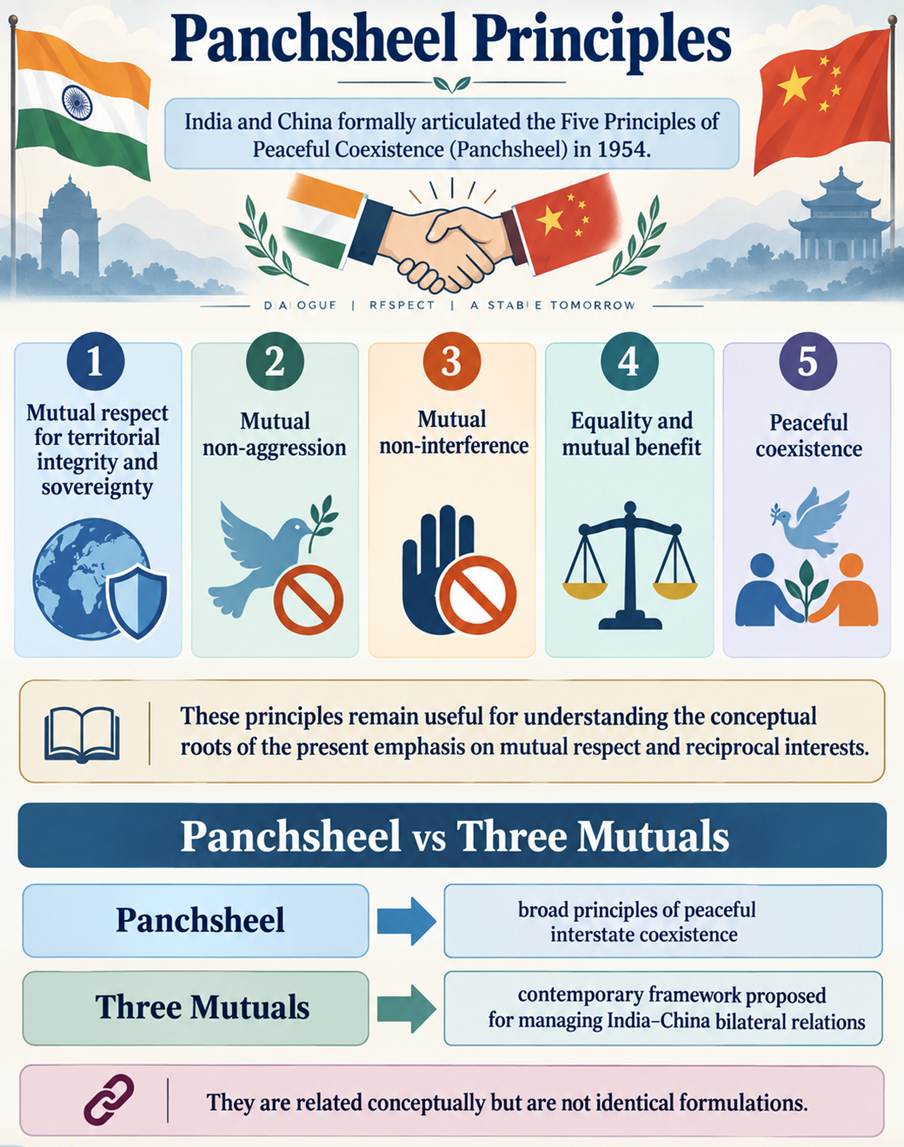
Panchsheel | 1954 |
India–China War | 1962 |
Peace and Tranquillity Agreement | 1993 |
Doklam | 2017 |
Wuhan Summit | 2018 |
Mamallapuram Summit | 2019 |
Galwan Clash | 2020 |
Eastern Ladakh understanding | 2024 |
Three Mutuals | Respect, Interest, Sensitivity |
LAC | India–China |
18th BRICS Summit | New Delhi, 2026 |
Mains Answer-Writing Value-Add
Micro-Dimensions:
Border stability | Economic interdependence | Regional competition | Diplomatic reciprocity
Keywords:
Reciprocal sensitivity, strategic autonomy, competitive interdependence, selective de-risking, calibrated normalisation, border-management architecture
Probable Mains Question
“Mutual respect, mutual interest and mutual sensitivity provide a useful framework for managing India–China relations, but cannot substitute for structural resolution of bilateral disputes.” Discuss in the context of the boundary question, economic interdependence and regional competition.
Prelims Readiness Drill
MCQ 1
With reference to India–China relations, consider the following statements:
- The “Three Mutuals” refer to mutual respect, mutual interest and mutual sensitivity.
- The Line of Actual Control is a mutually demarcated final international boundary.
- India has linked wider bilateral improvement with peace and tranquillity along the border.
Which of the statements given above are correct?
A. 1 only
B. 1 and 3 only
C. 2 and 3 only
D. 1, 2 and 3
Answer: B
Explanation: Statements 1 and 3 are correct. The LAC is not the final mutually demarcated international boundary.
Trap Identified: Effective control must not be confused with final boundary settlement.
MCQ 2
Consider the following pairs:
Event | Year |
Panchsheel Agreement | 1954 |
Doklam standoff | 2017 |
Galwan clash | 2020 |
How many of the above pairs are correctly matched?
A. Only one
B. Only two
C. All three
D. None
Answer: C
Explanation: All three pairs are correctly matched.
Trap Identified: Do not confuse Doklam with the 2020 eastern Ladakh/Galwan crisis.
More Current Affairs - Daily
- Election Commission of India: Constitutional Design and Evolution into a Three-Member Body 12 Oct 2026
- Loknayak Jayaprakash Narayan: Total Revolution and Contribution to Democracy 12 Oct 2026
- India’s Russia-Ukraine Initiative: From Black Sea Security to Strategic Autonomy 12 Oct 2026
- Jayaprakash Narayan: Architect of Total Revolution and Defender of Democracy 12 Oct 2026