How Parliament Convenes Special Sessions
Avdhesh Kumar · 16 November 2026 · RWA Civils Services
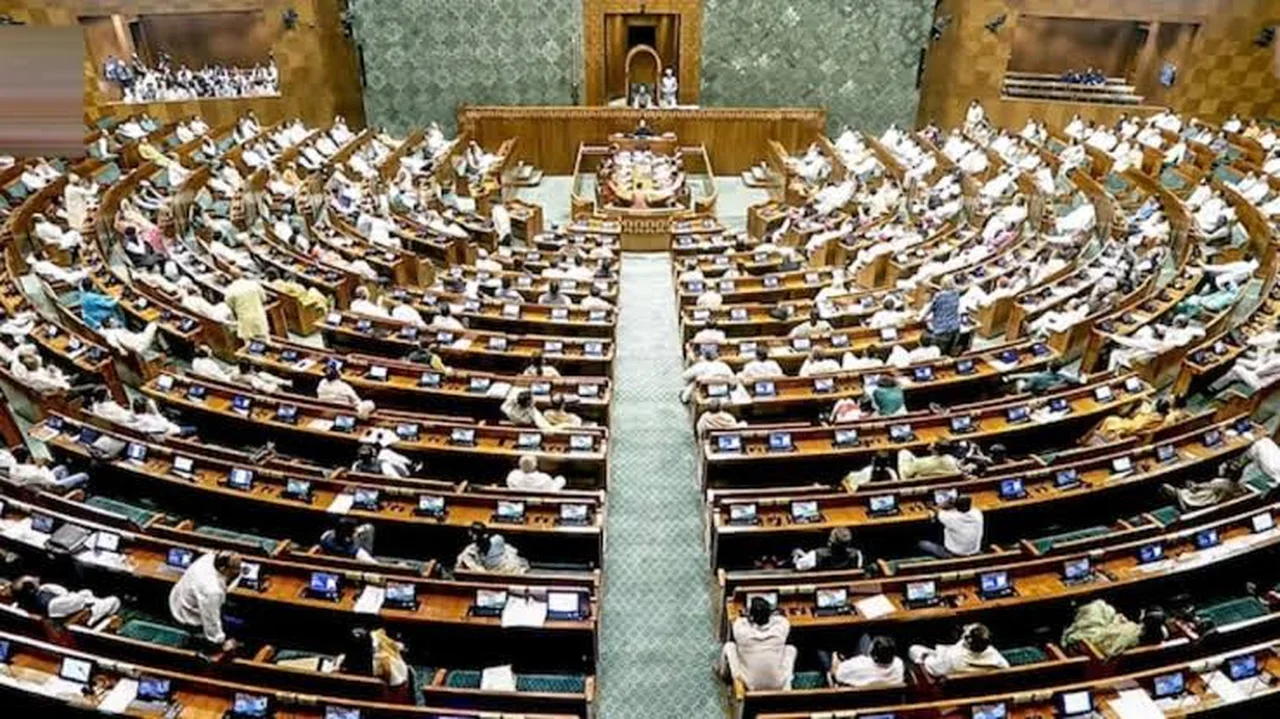
Special Session of Parliament: Constitutional Basis and Procedure
Syllabus Mapping: GS Paper II — Parliament, Constitutional Provisions, Parliamentary Procedure and Executive-Legislature Relations.
Source: The Indian Express, 13 NOVEMBER, 2026
Why in News?
A special session of Parliament may be convened before the regular Winter Session to take up major legislative business, including issues related to delimitation and implementation of women’s reservation.
This has renewed attention on how Parliament is summoned, what makes a special session different from an ordinary session, and why the distinction between adjournment sine die and prorogation matters.
Who Decides When Parliament Meets?
The initiative to convene Parliament rests with the Union government.
The Cabinet Committee on Parliamentary Affairs decides the timing and duration of a session.
The decision is then formally implemented by the President, in whose name Members of Parliament are summoned.
Thus, while the constitutional power is exercised by the President, the decision follows the advice of the government.
What Does Article 85 Provide?
Article 85 empowers the President to summon each House of Parliament from time to time.
It also provides that not more than six months may intervene between the last sitting of one session and the first sitting of the next session.
This means Parliament must meet at least often enough to satisfy the six-month constitutional requirement.
India does not have a constitutionally fixed annual parliamentary calendar.
The Three Conventional Sessions
By convention, Parliament normally meets in three major sessions:
- the Budget Session,
- the Monsoon Session, and
- the Winter Session.
These are conventions rather than constitutional categories.
Their dates and duration can change according to political, legislative and administrative requirements.
।
Does the Constitution Define a “Special Session”?
No.
The Constitution does not create a separate category called a special session of Parliament.
The term is used in political and parliamentary practice when a session is convened for a particular purpose, at an unusual time, or to mark an important national or parliamentary occasion.
Legally, such a session is still convened through the ordinary constitutional mechanism under Article 85.
Why Can a Special Session Be Called at Short Notice?
Regular sessions are usually preceded by a conventional notice period.
However, where an earlier session has been adjourned sine die but not prorogued, the session technically remains alive.
In such a situation, the House may be reconvened without beginning an entirely new session.
This allows greater procedural flexibility.
Adjournment Sine Die Versus Prorogation
These two terms are often confused.
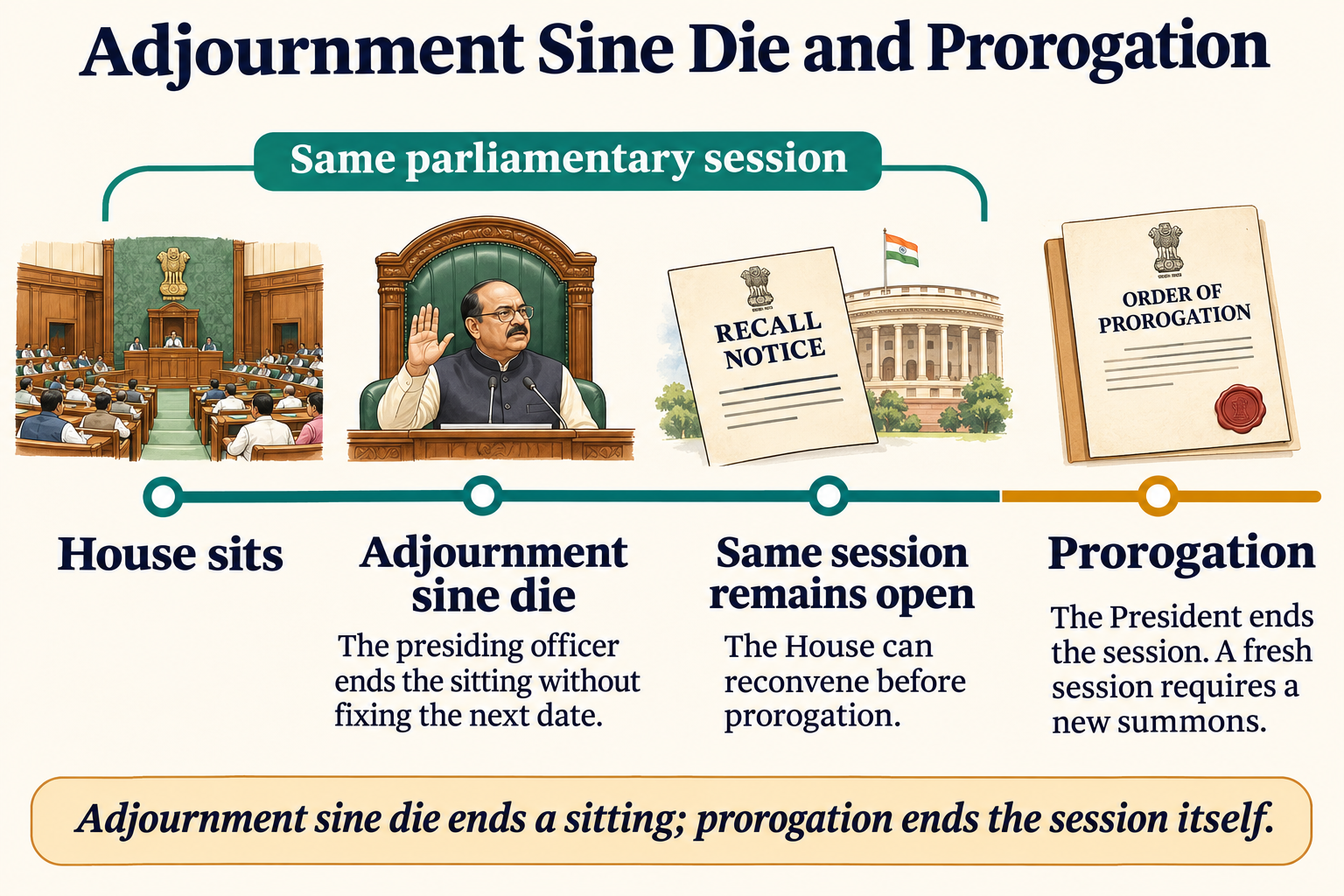
Adjournment sine die means that the presiding officer ends a sitting of the House without fixing a date for the next sitting.
It does not itself terminate the session.
Prorogation, by contrast, formally ends the session.
Prorogation is done by the President.
Therefore, a House that has been adjourned sine die but not prorogued remains within the same parliamentary session.
Role of Rule 15 of the Lok Sabha Rules
Where the Lok Sabha has been adjourned sine die but not prorogued, Rule 15 of the Rules of Procedure and Conduct of Business in Lok Sabha allows the Speaker to call the House to meet again before the date or time originally contemplated, if necessary.
This becomes especially important when the government wants Parliament to meet on short notice without formally starting a new session.
What Makes a Special Session Different in Practice?
A special session may have a narrower agenda than an ordinary session.
The presiding officers can structure proceedings around the specific purpose for which the House has been convened.
Certain regular devices, such as Question Hour, may not necessarily be available if the business schedule is specially designed for the session.
Therefore, the difference is more one of purpose, timing and procedure than constitutional status.
Can Governments Change Session Dates?
Yes.
Since India has no fixed parliamentary calendar, governments can advance, delay, shorten or split sessions.
Political events, elections, legislative priorities and the need to issue Ordinances have all influenced session timing in the past.
This gives the executive substantial control over the parliamentary calendar.
Why the Six-Month Rule Matters
The six-month limit is a minimum constitutional safeguard against the executive simply avoiding Parliament for prolonged periods.
It ensures periodic legislative oversight.
However, it does not require Parliament to sit for any minimum number of days in a year.
This is why debates periodically arise over whether India should adopt a more predictable or fixed parliamentary calendar.
What Is the “Special Sitting” Under Article 352?
Article 352 deals with a Proclamation of Emergency.
After the 44th Constitutional Amendment, a special safeguard was added.
If a Proclamation of Emergency is in force and the Lok Sabha is not in session, at least one-tenth of the total membership of the Lok Sabha can give notice seeking a special sitting to consider disapproval of the proclamation.
This is different from the ordinary political use of the term “special session”.
The Article 352 mechanism is a specific constitutional safeguard against misuse of emergency powers.
Why This Distinction Matters
A special session under ordinary parliamentary practice is convened through Article 85 and the normal executive process.
A special sitting under Article 352 is tied specifically to Emergency oversight.
Conflating the two can create conceptual confusion.
Core Policy Lesson
The Indian Constitution gives the executive substantial flexibility over when Parliament meets, subject to the six-month limit under Article 85.
A “special session” is therefore not a separate constitutional category but a session convened for a specific purpose or at an unusual time.
The distinction between adjournment sine die and prorogation is crucial because it determines whether the same session remains alive and can be reconvened quickly.
At the same time, Article 352 creates a separate and specific special sitting mechanism to strengthen parliamentary control over Emergency powers.
Probable Mains Question
“India’s constitutional framework gives the executive significant control over the parliamentary calendar, while providing only limited safeguards for regular legislative sittings.” Discuss with reference to Article 85, adjournment, prorogation and special sessions.
Prelims Drill
MCQ 1
With reference to sessions of Parliament, consider the following statements:
Article 85 provides that not more than six months shall intervene between two sessions of Parliament.
The Constitution expressly recognises Budget, Monsoon and Winter Sessions as three distinct constitutional categories.
The President formally summons Parliament.
Which of the statements given above are correct?
A. 1 only
B. 1 and 3 only
C. 2 and 3 only
D. 1, 2 and 3
Correct Answer: B
Explanation: Article 85 contains the six-month requirement and the President formally summons Parliament. Budget, Monsoon and Winter Sessions are conventions, not constitutionally defined categories.
MCQ 2
Consider the following statements:
Adjournment sine die ends a sitting without fixing the next date.
Prorogation formally ends a parliamentary session.
Article 352 contains a specific provision for a special sitting connected with parliamentary scrutiny of an Emergency proclamation.
Which of the statements given above are correct?
A. 1 only
B. 1 and 2 only
C. 2 and 3 only
D. 1, 2 and 3
Correct Answer: D
Explanation: Adjournment sine die and prorogation are distinct procedural acts, and Article 352 provides a specific mechanism for a special sitting in relation to an Emergency proclamation.