Conversion and Reservation
Religious conversion does not automatically transfer a person into another reserved community. Scheduled Caste status and backward-class identification follow distinct constitutional routes.
Conversion and Reservation
- Syllabus Mapping: GS Paper II — Fundamental Rights, Reservation, Social Justice and Constitutional Bodies.
- Source & Date: The Hindu, 21 October 2026.
Why in News?
The Supreme Court has upheld the Madras High Court’s decision striking down a Tamil Nadu government order that allowed certain persons who converted to Islam from BC, MBC, DNC and SC backgrounds to obtain Backward Class Muslim certificates and claim the State’s 3.5% reservation for BC Muslims.
The Court’s reasoning highlights a crucial distinction: conversion does not automatically create membership in another notified backward community.
Community Status Cannot Be Automatically Transferred
Tamil Nadu recognises seven notified backward Muslim communities. The courts held that a person who converts to Islam does not become a member of one of these communities merely because of conversion or previous Hindu caste status.
A Jamath may confirm that conversion occurred, but it cannot by itself determine statutory reservation status.
This is because a community certificate records a legally recognised status. It does not create that status.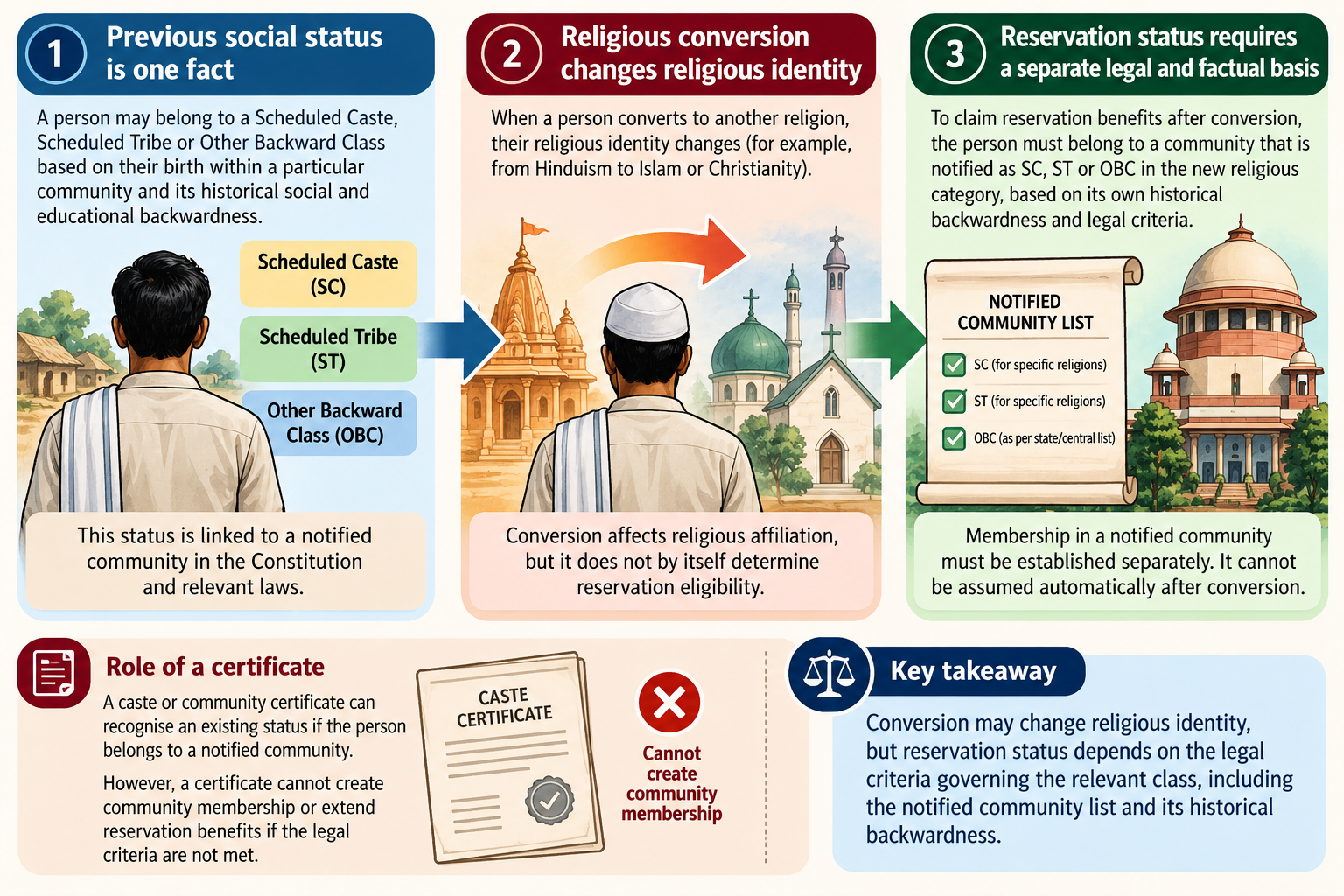
SC and OBC Routes Are Different
The Constitution treats Scheduled Castes and socially and educationally backward classes differently.
Under Article 341, the President specifies Scheduled Castes, while Parliament can alter the list. The Constitution (Scheduled Castes) Order, 1950 currently restricts SC status to persons professing Hinduism, Sikhism or Buddhism.
Therefore, under the existing framework, conversion to Islam or Christianity does not preserve SC status merely because the person belonged to an SC before conversion.
Backward-class classification follows a different route. Articles 15(4) and 16(4) permit special provisions for socially and educationally backward classes, while Article 342A, after the 105th Constitutional Amendment, recognises the power of States to maintain their own backward-class lists for State purposes.
Backwardness Requires Evidence
The judgment does not mean that Muslims or converts can never qualify as backward classes.
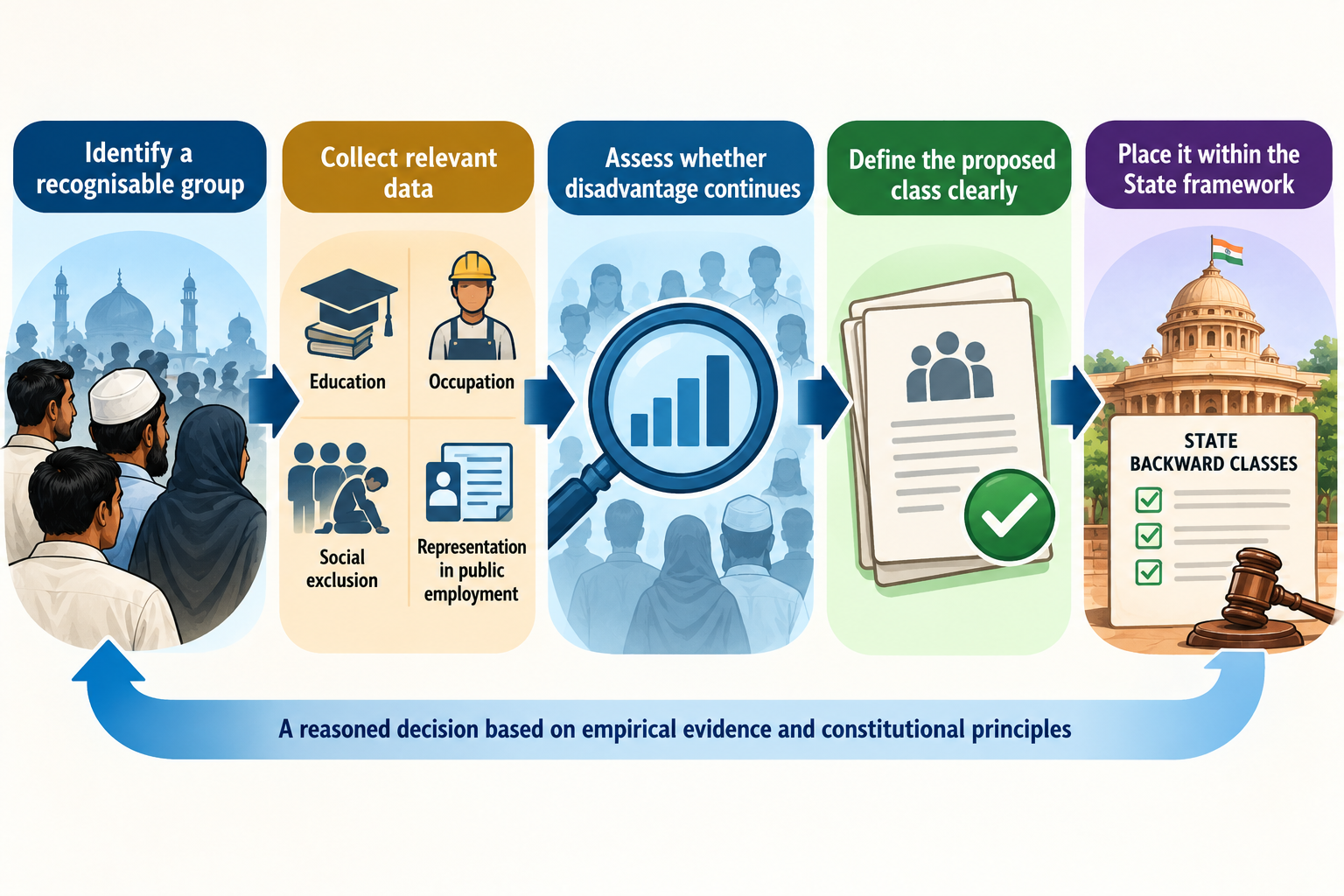
The constitutional issue is whether there is sufficient evidence that a recognisable group suffers social and educational disadvantage.
The Mandal Commission used social, educational and economic indicators to identify backwardness. Its wider principle remains relevant: classification must rest on a reasoned assessment rather than on labels alone.
A former Hindu BC or MBC may continue to face inherited disadvantage after conversion. But that fact does not automatically establish membership in an existing Muslim backward community.
Different Commissions Asked Different Questions
The Sachar Committee studied the social, economic and educational conditions of Muslims and found significant disadvantages, but also major regional differences.
The Ranganath Misra Commission recommended removing the religious restriction on SC status, but that recommendation has not altered the 1950 Order.
The K.G. Balakrishnan Commission was separately tasked with examining whether persons of historical SC origin who converted to other religions should receive SC status.
These exercises address different constitutional questions and cannot substitute for one another.
Way Forward
Tamil Nadu can still conduct a fresh empirical study through its Backward Classes Commission.
Such an inquiry should examine educational attainment, occupation, social acceptance, exclusion and representation in public employment among different groups of converts.
The key principle is balance. Conversion should not automatically erase inherited disadvantage, but the State also cannot assign a person to an existing reserved community without a lawful basis.
Core Policy Lesson
The judgment separates religious conversion from reservation classification.
SC status depends on Article 341 and the Presidential Order framework. Backward-class status depends on evidence of social and educational disadvantage under Articles 15(4), 16(4) and the State’s power under Article 342A.
The constitutional challenge is therefore to protect substantive equality without allowing reservation categories to be transferred mechanically across communities.
Probable Mains Question
“Religious conversion may alter legal identity without necessarily eliminating inherited social disadvantage.” Examine this statement in the context of Scheduled Caste status and backward-class reservation in India.
Prelims Drill
MCQ 1
With reference to reservation under the Constitution, consider the following statements:
- Article 341 empowers the President to specify Scheduled Castes.
- Parliament can alter the list of Scheduled Castes specified under Article 341.
- State governments have unrestricted power to modify the Presidential list of Scheduled Castes for State purposes.
Which of the statements given above are correct?
A. 1 only
B. 1 and 2 only
C. 2 and 3 only
D. 1, 2 and 3
Correct Answer: B
Explanation: Article 341 provides for specification of Scheduled Castes by the President, and Parliament can alter the list by law. States cannot independently modify the Presidential SC list.
MCQ 2
Consider the following statements regarding backward-class identification:
- Social and educational backwardness may be assessed using multiple indicators and need not depend exclusively on caste nomenclature.
- Article 342A, after the 105th Constitutional Amendment, recognises the role of States in maintaining backward-class lists for State purposes.
Conversion to another religion automatically transfers a person into the corresponding backward community of that religion.
Which of the statements given above are correct?
A. 1 only
B. 1 and 2 only
C. 2 and 3 only
D. 1, 2 and 3
Correct Answer: B
Explanation: Backward-class identification can rely on a broader assessment of social and educational disadvantage. States retain authority over their own lists for State purposes, but conversion does not by itself create membership in another notified backward community.