
EV Retrofitment in India
EV retrofitment can provide an alternative path to cleaner mobility by converting existing petrol and diesel vehicles into electric vehicles instead of waiting for the entire fleet to be replaced.
EV Retrofitment in India
- Syllabus Mapping: GS Paper III — Science and Technology, Infrastructure, Energy Security, Employment and Environmental Conservation.
- Source & Date: The Hindu, 21 October 2026.
Why in News?
Electric-vehicle retrofitment is emerging as a possible new mobility opportunity for India. It involves converting an existing petrol or diesel vehicle into an electric vehicle by replacing the internal-combustion powertrain while retaining much of the original vehicle structure.
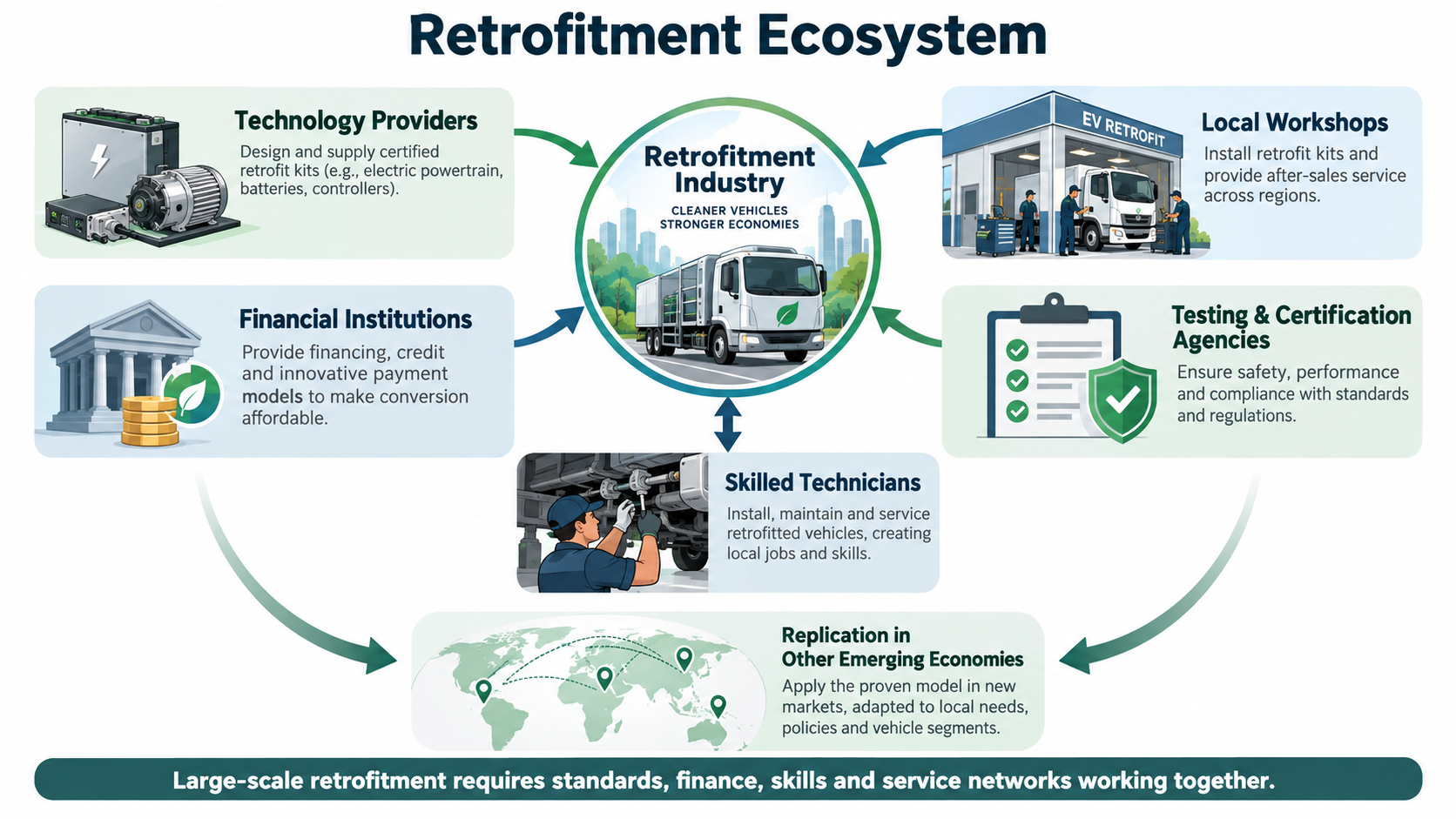
The larger opportunity lies not only in conversion itself, but in building an ecosystem of diagnostics, batteries, electronics, software, testing, finance, installation and skilled servicing.
Why Retrofitment Matters
India has a very large stock of petrol and diesel vehicles. Replacing this entire fleet with newly manufactured EVs would take many years.
Retrofitment offers another pathway. Instead of discarding a usable vehicle, its powertrain can be replaced and the remaining vehicle can continue to be used.
This can extend vehicle life, reduce fossil-fuel consumption and lower the material requirement associated with manufacturing an entirely new vehicle.
India Has a Structural Advantage
Unlike large automobile manufacturing plants, retrofitment can operate through a decentralised network of certified workshops.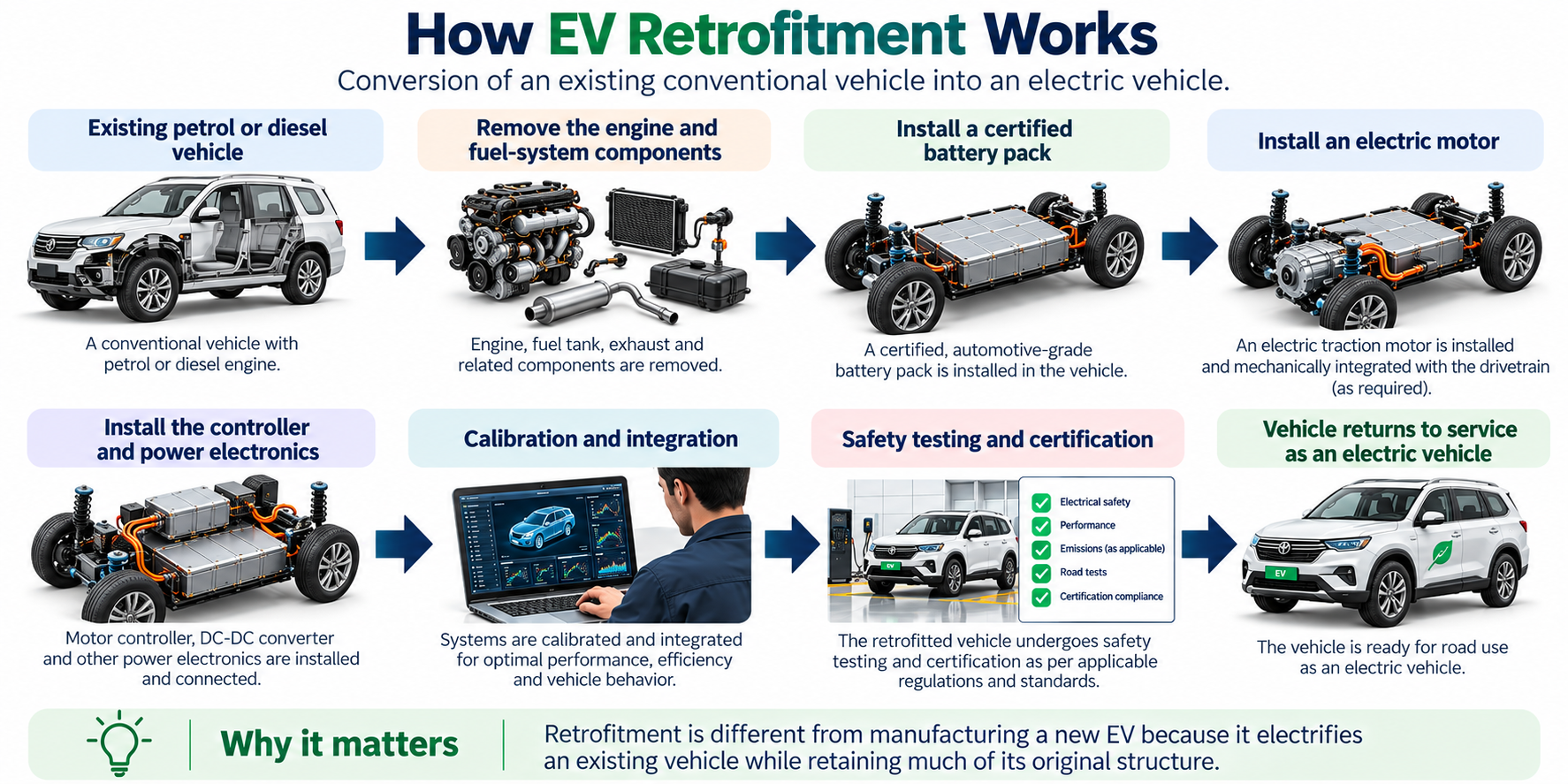
India already has millions of mechanics, garages and spare-parts businesses across metropolitan areas, smaller towns and rural regions. With proper training and certification, part of this informal automotive workforce could move into EV conversion and maintenance.
This could create local employment while reducing the need to concentrate the entire transition in a few large factories.
Standards Are Critical
Retrofitment cannot be treated as an informal modification because batteries and high-voltage systems involve serious safety risks.
India already permits specified electric conversions under the Central Motor Vehicles framework. Pure-electric retrofit kits are required to meet relevant AIS-123 standards, while kit manufacturers or suppliers require type approval from designated testing agencies.
A successful industry therefore requires certified kits, trained installers, reliable batteries and clear accountability for safety.
Energy Security Gains
India imports most of the crude oil it consumes. Electrifying existing vehicles can reduce petrol and diesel demand more quickly than relying only on the gradual sale of new EVs.
The benefit is particularly relevant for countries where vehicles remain on the road for long periods.
For India, retrofitment can therefore support both decarbonisation and energy security.
Opportunity for the Global South
Many developing economies share India's conditions: ageing vehicle fleets, price-sensitive consumers and dependence on imported petroleum.
If India develops reliable certification, training, financing and service models, it could export not just retrofit kits but an entire implementation framework.
This resembles India's digital-public-infrastructure experience, where the value lies in creating a scalable system rather than merely an individual product.
Key Challenges
Retrofitment still faces important barriers. Conversion costs must be low enough to justify extending the life of an older vehicle. Battery quality, fire safety, insurance, financing, warranties and resale value also need clarity.
Poor-quality conversion could damage consumer trust and create safety risks. Regulation and enforcement must therefore grow alongside the market.
Core Policy Lesson
EV retrofitment should not be seen merely as a temporary bridge until new EVs become cheaper.
If supported by strong standards, financing, skilling and certification, it could become a distinct clean-mobility industry. For India, its wider value lies in combining fleet electrification, local employment, lower oil dependence and technological capability.
Probable Mains Question
“Electric-vehicle retrofitment can complement new EV manufacturing in accelerating India’s mobility transition.” Discuss its potential for energy security, employment and clean transport, along with the regulatory challenges involved.
Prelims Drill
MCQ 1
With reference to electric-vehicle retrofitment in India, consider the following statements:
- Retrofitment can involve retaining the original vehicle structure while replacing the conventional powertrain with an electric propulsion system.
- Approval of an electric retrofit kit makes safety certification of the converted vehicle unnecessary.
- Technical standards can prescribe requirements relating to construction, braking and electric energy consumption.
Which of the statements given above are correct?
A. 1 only
B. 1 and 3 only
C. 2 and 3 only
D. 1, 2 and 3
Correct Answer: B
Explanation: Retrofitment retains much of the existing vehicle while changing its propulsion system. Approved systems remain subject to prescribed technical and safety requirements; type approval does not eliminate the need for compliance.
MCQ 2
Consider the following statements regarding large-scale vehicle electrification:
- Electrifying existing vehicles can influence petroleum demand without requiring the complete replacement of the vehicle fleet.
- Decentralised retrofitment networks can potentially use existing automotive service and repair infrastructure.
- Lower crude-oil consumption necessarily implies lower overall electricity demand in the economy.
Which of the statements given above are correct?
A. 1 only
B. 1 and 2 only
C. 2 and 3 only
D. 1, 2 and 3
Correct Answer: B
Explanation: Retrofitment can reduce liquid-fuel use while using existing service networks. However, greater transport electrification increases electricity demand, so lower petroleum consumption does not imply lower total electricity demand.