
India-New Zealand FTA
The India-New Zealand FTA combines goods trade with services, professional mobility, investment cooperation and safeguards for sensitive agricultural sectors.
India-New Zealand FTA
- Syllabus Mapping: GS Paper II — Bilateral Relations; GS Paper III — External Sector, Trade Agreements, Investment and Agriculture.
- Source & Date: The Hindu, 20 October 2026.
Why in News?
The India-New Zealand Free Trade Agreement entered into force on October 20, 2026, after being signed in April and ratified in September. New Zealand now provides zero-duty access across all tariff lines for Indian exports, while India has offered tariff concessions on about 70% of its tariff lines, covering roughly 95% of bilateral trade value.
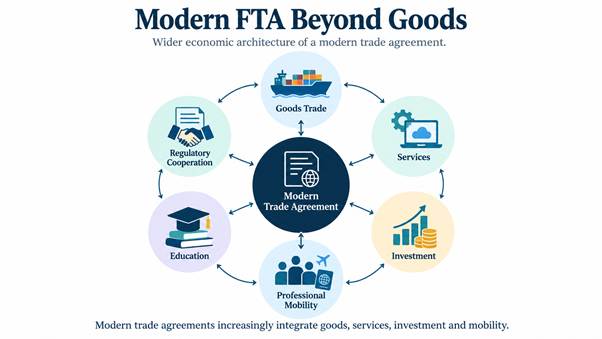
The agreement also goes beyond goods trade by including investment, services and new mobility pathways for Indian students and professionals.
Full Access for Indian Exports
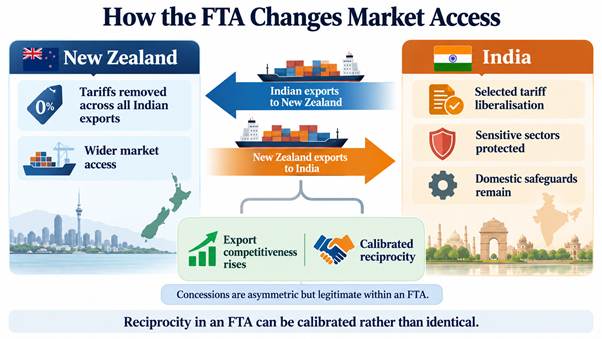
New Zealand has eliminated customs duties on 100% of Indian exports from the first day of implementation. This removes tariffs that earlier reached around 10% on several Indian products.
Sectors expected to benefit include textiles, leather, pharmaceuticals, engineering goods, processed foods, marine products and agricultural products. The advantage is especially important for labour-intensive sectors where even a modest tariff can affect competitiveness.
This is significant because India has secured complete duty-free market access without offering equally unrestricted access in return.
India Protects Sensitive Sectors
India has liberalised about 70% of tariff lines, but nearly 30% remain excluded. Sensitive sectors include several dairy and agricultural products where unrestricted imports could put pressure on domestic producers.
For products such as apples and kiwifruit, India has used tariff-rate quotas and other safeguards rather than complete unrestricted liberalisation.
This reflects a broader principle of trade negotiations: market opening can be combined with protection for sectors where livelihood concerns are significant.
Services and Mobility
The FTA also creates new pathways for Indian professionals and students.
Two Temporary Employment Entry visa categories allow up to 5,000 Indian visa holders at any one time, largely in skilled occupations. The agreement also expands post-study work opportunities and creates a working holiday arrangement.
These provisions matter because modern FTAs increasingly cover not only movement of goods but also services and temporary movement of professionals.
Investment Dimension
New Zealand has committed to facilitating $20 billion of investment into India over 15 years, with potential benefits for manufacturing, infrastructure, innovation and employment.
However, such commitments should be understood as an investment-facilitation objective rather than an automatic flow of capital. Actual investment will depend on commercial opportunities and the domestic investment climate.
Strategic Significance
For India, the agreement supports export diversification and deeper engagement with the Indo-Pacific economy. For New Zealand, it provides greater access to a large and rapidly growing Indian market.
It also reflects India’s recent approach to FTAs: seek stronger export access while protecting politically and economically sensitive sectors through exclusions, quotas and phased liberalisation.
Core Policy Lesson
The India-New Zealand FTA is not simply a tariff-cutting agreement. It combines export access, selective import liberalisation, agricultural safeguards, services mobility and investment cooperation.
Its success will ultimately depend on whether Indian firms are able to convert preferential market access into higher exports, investment and employment.
Probable Mains Question
“Modern free trade agreements go well beyond tariff reduction and increasingly combine trade, investment and mobility.” Examine this statement with reference to the India-New Zealand FTA.
Prelims Drill
MCQ 1
With reference to Free Trade Agreements, consider the following statements:
- An FTA necessarily requires both parties to eliminate tariffs on an identical number of tariff lines.
- Sensitive products may be excluded from tariff liberalisation under an FTA.
- Tariff-rate quotas can allow a specified quantity of imports at a preferential tariff while applying a different tariff beyond that quantity.
Which of the statements given above are correct?
A. 1 and 2 only
B. 2 and 3 only
C. 1 and 3 only
D. 1, 2 and 3
Correct Answer: B
Explanation: FTA commitments need not be numerically identical between partners. Sensitive products can be excluded, while tariff-rate quotas allow calibrated market access without complete tariff elimination.
MCQ 2
Consider the following statements regarding modern trade agreements:
- They may contain commitments relating to temporary movement of professionals.
- They may include provisions dealing with investment and regulatory cooperation.
- The inclusion of services provisions automatically grants permanent migration rights to service providers.
Which of the statements given above are correct?
A. 1 only
B. 1 and 2 only
C. 2 and 3 only
D. 1, 2 and 3
Correct Answer: B
Explanation: Modern FTAs often include services, investment and temporary professional mobility. Such provisions do not automatically create permanent migration or residence rights.

More Current Affairs - Daily
- 5th Edition of India-Australia Joint Military Exercise AUSTRAHIND 2026 Begins 21 Oct 2026
- Visual Snow Syndrome: Understanding Persistent Static-Like Visual Disturbances 21 Oct 2026
- Access, Quality and Trust in Healthcare 21 Oct 2026
- Mission for Aatmanirbharta in Pulses: Why Is It Important for India? 21 Oct 2026