
Access, Quality and Trust in Healthcare
Good healthcare is not limited to treating disease. It also requires affordable medicines, safe treatment, reliable evidence, informed choices and continuity of care throughout life.
Access, Quality and Trust in Healthcare
- Syllabus Mapping: GS Paper II — Health, Social Justice, Welfare and Government Policies; GS Paper III — Science and Technology.
Source & Date: The Hindu, 20 October 2026.
Why in News?
Recent debates around expensive medicines, unnecessary treatment, quality of medical research, ageing, maternal care and new diagnostic technologies highlight a larger problem in healthcare.
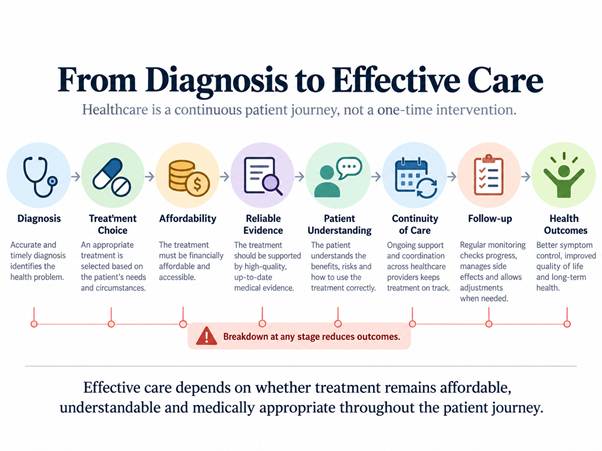
A health system cannot be judged only by whether a treatment exists. It must also be judged by whether people can afford it, understand it, access it safely and trust the evidence behind it.
Affordability Shapes Access
The price of medicines can determine whether patients continue treatment, especially in cancer, rare diseases and chronic illnesses. Price regulation can reduce financial burden, but affordability also depends on hospital charges, diagnostics, transport costs and repeated follow-up visits.
This means access to healthcare is not simply about the physical availability of doctors or medicines. It also depends on whether households can use those services without suffering severe financial hardship.
More Treatment Is Not Always Better
Healthcare can fail through under-treatment, but it can also fail through overtreatment.
Unnecessary tests, multiple medicines and avoidable procedures can increase costs and expose patients to side effects. This is particularly important for older people and those with several chronic diseases who may already be taking many medicines.
Safe care therefore requires doctors to ask not only what can be prescribed, but also what is actually necessary.
Evidence Must Be Reliable
Modern healthcare depends heavily on scientific research. Doctors use published studies to decide whether a medicine, diagnostic test or treatment is effective.
Weak or fraudulent research can therefore affect later studies, clinical guidelines and patient care. New diagnostic tools must also be validated across different populations before they become part of routine medicine.
Research integrity is therefore a public-health issue, not only an academic concern.
Patients Need Informed Choice
Medical decisions are becoming more complicated as treatment options increase.
Patients may face different medicines, procedures and risk estimates, often while physically or emotionally stressed. Too many choices without clear communication can reduce rather than improve autonomy.
Patient-centred healthcare requires doctors to explain benefits, risks, uncertainties and alternatives in a form that people can understand.
Care Must Continue Across Life
Healthcare often becomes fragmented after the immediate medical event ends.
A mother may still need physical and mental-health support after childbirth. An elderly person may require rehabilitation, social support and long-term disease management. People living with disabilities or chronic diseases need continuity rather than episodic treatment.
This makes continuity of care a central part of healthcare quality.
Climate and Social Conditions Matter
Health is also shaped outside hospitals.
Heat, air pollution, poor nutrition, unsafe housing and infectious-disease outbreaks affect disease patterns. Marginalised communities may face additional barriers because of poverty, geography or social exclusion.
Healthcare policy must therefore link medical services with prevention, environmental health and social determinants of health.
Core Policy Lesson
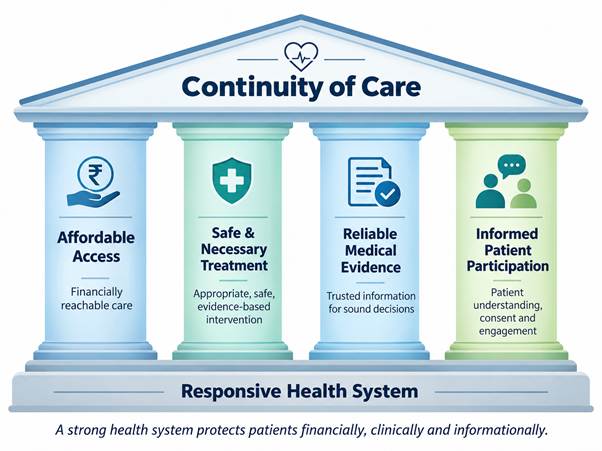
A strong health system must move beyond measuring success only through hospitals, doctors and new technologies.
The real goal is to ensure that people receive affordable, necessary, evidence-based and continuous care while retaining dignity and informed choice.
Universal health coverage therefore means more than access to treatment. It means access to care that people can safely use and trust.
Probable Mains Question
“Healthcare access is meaningful only when treatment is affordable, evidence-based and patient-centred.” Discuss the major barriers to achieving such a health system in India.
Prelims Drill
MCQ 1
With reference to evidence-based healthcare, consider the following statements:
- Clinical decisions may depend on the quality and reliability of published medical research.
- A diagnostic test that detects a biological difference is necessarily suitable for routine clinical use.
- Validation across different patient populations can be relevant before adopting a new diagnostic method widely.
Which of the statements given above are correct?
A. 1 only
B. 1 and 3 only
C. 2 and 3 only
D. 1, 2 and 3
Correct Answer: B
Explanation: Research quality directly affects clinical knowledge. A detectable biological signal is not automatically clinically useful; its accuracy and reliability must be validated across appropriate populations.
MCQ 2
With reference to patient-centred healthcare, consider the following statements:
- Increasing the number of treatment options necessarily increases meaningful patient autonomy.
- Polypharmacy can increase the risk of adverse effects, particularly among patients with multiple chronic conditions.
- Continuity of care may remain important even after the immediate disease episode or medical procedure has ended.
Which of the statements given above are correct?
A. 1 and 2 only
B. 2 only
C. 2 and 3 only
D. 1, 2 and 3
Correct Answer: C
Explanation: More choices do not automatically improve autonomy when patients cannot understand their implications. Polypharmacy can increase treatment-related risks, while long-term follow-up is essential in chronic disease, ageing and post-treatment care.